Cold Weather E-Bike Performance: How Temperature Drastically Affects Battery Range and Longevity.
For year-round e-bike riders, the arrival of winter brings a noticeable drop in performance. This isn't due to a flawed battery, but rather the immutable laws of electrochemistry. Lithium-ion batteries function optimally near room temperature ($20^\circ C / 68^\circ F$). When temperatures drop, two severe performance inhibitors occur: reduced temporary capacity (range loss) and increased risk of permanent degradation if charged improperly. Understanding these effects is key to safe, efficient e-bike battery cold weather operation.
Part II: The Critical Danger – Charging in the Cold
2. The Permanent Risk of Lithium Plating
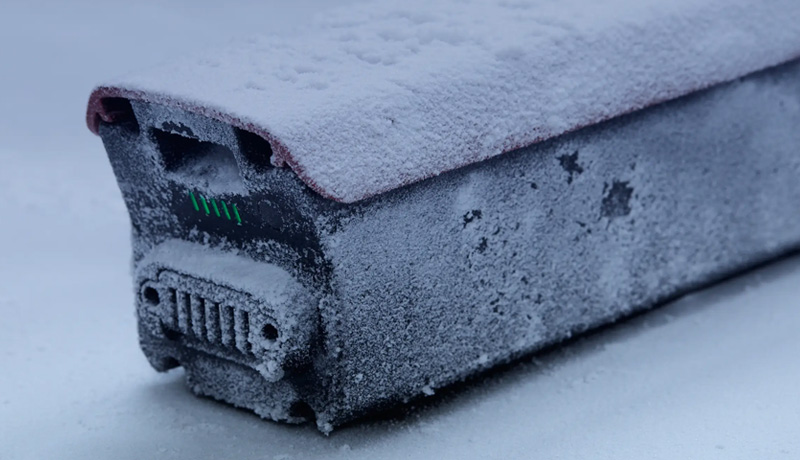
While riding in the cold only causes temporary range loss, charging a lithium-ion battery below freezing ($0^\circ C / 32^\circ F$) poses a severe, permanent risk known as lithium plating.
When the temperature is too low, the lithium ions cannot intercalate into the anode's graphite structure quickly enough. Instead of entering the anode, the ions deposit on the surface of the anode as metallic lithium. This plated lithium:
- Reduces Capacity: It is permanently sequestered from the active chemistry, reducing the pack's usable capacity forever.
- Creates Internal Shorts: Over time, these lithium dendrites can grow large enough to pierce the separator, causing a dangerous internal short circuit that can lead to thermal runaway, even days later.
The Safety Protocol: Never charge a lithium-ion battery if its core temperature is below $0^\circ C (32^\circ F)$. Always bring the battery inside and allow it to warm up to room temperature for several hours before plugging in the charger.
Part III: Best Practices for Winter Riding and Storage
3. Mitigating Cold-Weather Range Loss
Riders can mitigate the temporary effects of cold:
- Pre-Warming: Store the battery indoors at room temperature right up until the moment you leave. A warm start dramatically extends the functional range.
- Insulation: Use an external, insulated battery cover (often made of neoprene) during the ride. This helps retain the heat generated internally during discharge, keeping the cells warmer and resistance lower.
- Riding Style: Use lower pedal-assist levels. Demanding less current from the battery keeps the internal resistance from causing sharp voltage sag, improving efficiency.
4. Long-Term Winter Storage
If the e-bike will be stored for the season, follow the established longevity protocol:
- State of Charge (SoC): Store the battery at $50\%$ to $60\%$ SoC (the most chemically stable state).
- Temperature: Store in a cool, dry place, ideally between $0^\circ C$ and $20^\circ C$ ($32^\circ F$ and $68^\circ F$). This cool temperature significantly slows down the calendar aging process, preserving the cells' health for spring.
Protect Your Investment Through Proactive Temperature Management.
Managing your battery's temperature is the single most important action for ensuring its health and safety during winter. By following these protocols, you protect your investment from both temporary range loss and permanent chemical damage.
Need a Battery Built for All-Weather Performance?
ShunTongDa Battery packs feature advanced BMS with integrated thermal protection that strictly limits charging and discharge outside of safe temperature parameters. Our cold-weather performance is engineered to minimize resistance effects. Ride year-round with confidence, powered by ShunTongDa Battery.