Can I Turn My E-Bike On While Charging?
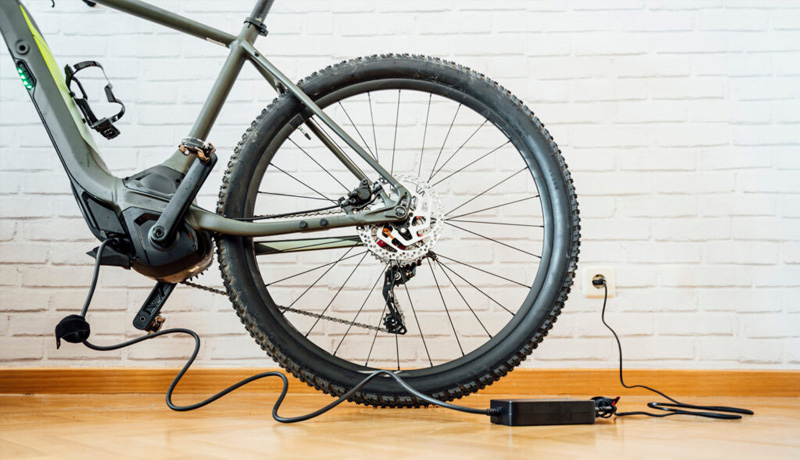
It’s a common scenario: you plug in your bike, but you want to check the voltage, adjust the pedal assist level, or turn on the lights. Is it safe to activate the bike while the charger is connected?
The short answer is Yes, in almost all modern e-bike systems, you can safely turn the key or press the power button to activate the display and accessories while the battery is plugged in.
However, the key distinction is that while the bike is on, you generally cannot draw high power from the motor—and this is a critical safety feature built directly into the battery's architecture.
To understand why this is safe, we need to look past the charger plug and examine the sophisticated internal wiring of the Battery Management System (BMS).
The Secret: Separate Paths for Power
The reason your e-bike can simultaneously be connected to the wall charger and power the display lies in the dual-port architecture common in high-quality battery packs.
1. The Discharge Path (The Bike's Power)
The large wires leading from the battery to the motor controller (usually connected via Anderson or XT90 plugs) are the discharge path. This path is responsible for handling the high continuous current (often 20A to 60A) required to run the motor.
2. The Charge Path (The Wall Plug)
The smaller port where your charger connects is the charge path. This path handles the lower, constant charging current (usually 2A to 5A).
The BMS acts as the traffic controller, using two separate sets of MOSFET switches (transistors): one set to manage current flow in and one set to manage current flow out.
When the charger is plugged into the charge port, the BMS prioritizes the charging function. If the bike attempts to draw high current (e.g., you twist the throttle), the BMS will often recognize the conflicting demand and instantly sever the high-power discharge path, preventing the motor from activating.
This protection mechanism is designed to prevent a dangerous situation known as "Charge and Discharge Conflict."
The Danger Zone: Charge and Discharge Conflict
Why does the BMS need to stop the motor when the charger is connected?
- Current Overload: If the battery tried to simultaneously accept 4A from the charger and push out 30A to the motor, the internal circuitry of the BMS (specifically the common ground or the monitoring leads) would be subjected to severe, unplanned current spikes, potentially leading to immediate BMS failure or even a thermal event.
- Voltage Instability: Running the motor causes a temporary voltage drop (known as "sag"). This sag would confuse the external charger, which relies on steady voltage readings to regulate the charging process. This voltage confusion can lead to inefficient charging cycles or, worse, a momentary loss of control over the charging current.
In Summary: The power to run the display, lights, and low-draw accessories (which typically require less than 0.5A) is generally allowed by the BMS. However, any attempt to engage the motor or draw high amps will be blocked by the BMS to protect itself and the charging electronics.
Safety Precautions and Exceptions
While safe on most systems, there are a few scenarios where caution is advised:
Exception 1: Single-Port Systems (3-Pin XT Connectors)
Some older or budget battery packs use a single connector (e.g., a 3-pin connector common on some Hailong packs) for both charging and discharging. In these systems, the high-current motor wires may be physically connected to the low-current charging wires inside the bike's harness.
If you encounter such a system, **it is best practice to keep the bike powered off while charging.** If the power button is on, a failure could route high current through the small charging cable, causing it to overheat and melt.
Exception 2: Diagnostic Use
Turning the bike on while charging is highly useful for diagnostics. You can observe the **real-time voltage** on the display to verify the charger is working, and you can check if all accessories (lights, horn) are functional without stressing the cells.
Pro-Tip: Checking the Display Voltage
If your display shows the voltage while charging, you will notice the number is slightly inflated (e.g., 54.6V for a 52V battery). This is the voltage being delivered by the charger, not the resting voltage of the cells. Once unplugged, the voltage will drop slightly as the cells stabilize.
Conclusion
In modern e-bikes with robust Battery Management Systems and separate charge/discharge paths, turning the bike on while charging is electrically safe. The BMS is engineered to prioritize safety, preventing the high-current motor circuit from engaging while the battery is receiving power from the wall.
Always refer to your e-bike manufacturer's manual, but generally, checking your battery status or turning on your lights while plugged in poses no risk.