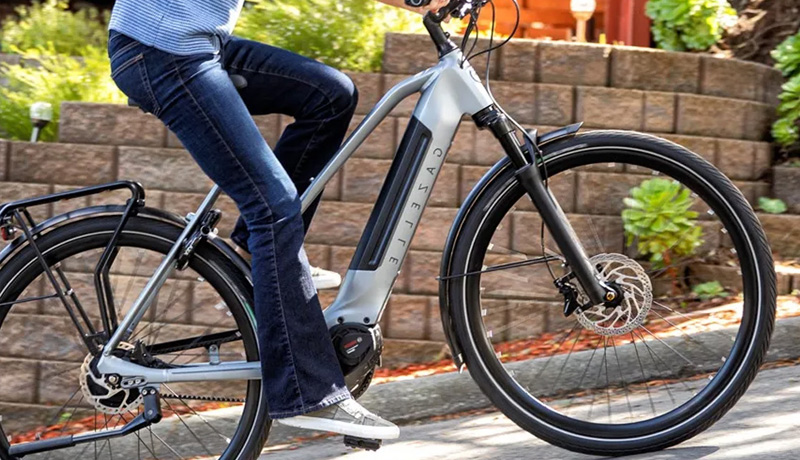
Do Ebike Batteries Go Bad If Not Used? The Hidden Dangers of Storage
It’s a common misconception that batteries only degrade when actively used. In reality, improper storage is one of the fastest ways to permanently kill your expensive e-bike pack.
If you put your e-bike away for a long period—perhaps for winter storage, or during a long vacation—you need to follow specific steps to ensure the battery remains healthy. If left alone, two major chemical processes can destroy the pack's capacity and safety:
- Self-Discharge & Deep Discharge Damage (Too Low Voltage)
- Accelerated Chemical Degradation (Too High Voltage)
Let's dive into the science behind why a resting Lithium-ion battery needs more care than you might think.
1. The Silent Killer: Self-Discharge and Deep Discharge
All batteries, including the Lithium-ion cells in your e-bike, experience self-discharge. This means they slowly lose charge even when disconnected from the bike and the charger.
The Role of Parasitic Drain (BMS)
While the self-discharge rate of the bare cells is low (usually less than 3% per month), the Battery Management System (BMS) inside the pack is always active, drawing a small quiescent current to monitor the cell groups.
If you store your battery at a very low State of Charge (SoC)—say, 10%—the BMS will eventually drain the remaining energy. When the voltage drops below the critical threshold (typically 2.5V per cell), the BMS will trip into an emergency safety shutdown. This is called Deep Discharge.
Once a cell group has been severely deep discharged, it suffers permanent chemical damage. When you attempt to recharge it, its capacity may be significantly lower, or the BMS may refuse to charge it at all, rendering the entire battery pack unusable.
The Danger Timeline: If you store a 48V battery at 10% charge (approximately 42V) for six months without checking it, the combination of self-discharge and BMS parasitic drain can push the voltage below the safe limit.

2. Accelerated Degradation: The Stress of 100%
While low voltage causes immediate, catastrophic failure, high voltage causes slow, permanent capacity fade.
As we discussed in a previous post, storing a battery at 100% State of Charge (4.2V per cell) is equivalent to keeping a rubber band fully stretched. This high voltage puts continuous stress on the internal chemistry, specifically accelerating the degradation of the Solid Electrolyte Interphase (SEI) layer and oxidizing the cathode material.
The higher the voltage and the higher the temperature during storage, the faster the capacity loss. Storing a battery at 100% in a hot garage (above 30°C) is the fastest way to permanently reduce your e-bike's range, even if the battery is never used.
The Golden Rule: Optimal Storage Voltage (The 60% Rule)
Based on extensive research by NASA and major cell manufacturers, there is an ideal voltage level for long-term storage where both self-discharge risks and voltage stress are minimized:
The optimal charge level for storage is 50% to 60% State of Charge (approximately 3.7V to 3.8V per cell).
| Battery Voltage (Typical) | Storage SoC | Safety/Longevity Risk |
|---|---|---|
| $4.2V \times S$ (100%) | High Stress | Accelerated capacity fade. |
| $3.7V \times S$ (60%) | Ideal | Minimal stress; safe against self-discharge. |
| $2.5V \times S$ (0%) | Extreme Risk | Permanent deep discharge and cell death. |
Long-Term Storage Checklist (Winterization)
Follow these three steps when storing your e-bike battery for more than two months:
- Set the Charge Level: Discharge or charge the battery until it is near the 60% level (approximately 3.7V per cell). Do not store it full (100%) or empty (0%).
- Control the Temperature: Store the battery in a cool, dry, climate-controlled environment, ideally between $5^\circ C$ and $20^\circ C$ ($41^\circ F$ and $68^\circ F$). Never store it in a freezing garage or a hot attic.
- The Monthly Check: Due to the small parasitic drain from the BMS, check the voltage every 1-2 months. If the voltage has dropped significantly (e.g., dipping below 40% SoC), top it back up to the 60% storage level to prevent the deep discharge trap.
Warning on Old Batteries
Older batteries naturally self-discharge faster. If your pack is 3+ years old, be especially vigilant about the monthly voltage check, as its internal resistance is higher and its voltage stability is lower.
Conclusion
The short answer is yes, e-bike batteries can absolutely go bad if not used—but the cause is poor management, not lack of use itself. By following the 60% storage rule and keeping the pack at room temperature, you are protecting its chemical integrity and ensuring maximum range for the next riding season.