Do E-Bikes Stop Charging When Full? The Technology That Saves Your Battery
It’s the question every new e-bike owner asks. Understanding the answer is the key to both safety and maximizing your battery’s lifespan.
The short and definitive answer is Yes, modern e-bike batteries are designed to stop charging automatically when they reach full capacity.
However, relying solely on this automatic shutoff without understanding how it works—and how it can fail—is a common mistake that leads to premature battery death and, in rare cases, safety issues.
Unlike simple AA batteries, your e-bike battery is a complex system involving multiple layers of electronic protection. We'll break down the two main components responsible for charging control: the Battery Management System (BMS) and the External Charger.
The Dynamic Duo: BMS and Charger
The charging process relies on a communication and verification loop between the battery pack (specifically the internal BMS) and the charger you plug into the wall. Both have safety protocols, but they serve different primary functions.
1. The External Charger (The Power Supply)
Your charger uses a Constant Current/Constant Voltage (CC/CV) charging profile:
- Constant Current (CC) Phase: When the battery is low, the charger pushes maximum safe current (Amps) into the battery.
- Constant Voltage (CV) Phase: As the battery approaches 80% to 90% full, the charger switches to maintaining a constant maximum voltage (e.g., 42V for a 36V pack). The current flow automatically begins to drop dramatically.
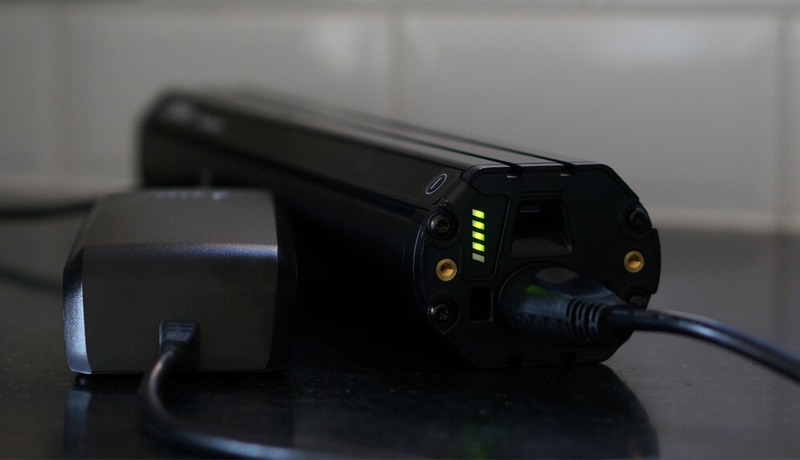
The Shutoff Signal: The charger automatically cuts off the power (or switches its light from red/orange to green) when the current flowing into the battery drops below a predetermined, very low threshold (often called the termination current). At this point, the battery cells have peaked at their maximum safe voltage (4.2V per cell).
2. The BMS (The Absolute Backup)
The Battery Management System is the internal circuit board that monitors every single cell group. Its primary function during charging is emergency protection.
Even if the external charger were to malfunction and keep pushing current, the BMS has a hardware-based safety cutoff. If any single cell group attempts to exceed the critical maximum voltage (typically around 4.25V), the BMS will instantly open its internal MOSFET switches, physically disconnecting the charging port from the cells. This is the ultimate safety net against overcharging, which is the leading cause of Lithium-ion fire.
Technical Note: For a typical 10S (36V) e-bike battery, the maximum voltage is $10 \times 4.2V = 42V$. If the charger fails, the BMS will cut the charge typically at $10 \times 4.25V = 42.5V$.
What Happens When Protection Fails?
Understanding the safety mechanism reinforces why we, as experts, strongly advise against leaving the battery plugged in indefinitely (as discussed in our previous post).
The automatic shutoff mechanism works, but it is not infallible. A fire hazard occurs when both the external charger and the internal BMS fail simultaneously—a double failure.
- Charger Failure: Poorly regulated, cheap chargers can fail to detect the termination current and continue pushing a small, damaging current (trickle charge).
- BMS Failure: If the BMS's monitoring circuits or power switches (MOSFETs) fail in a closed state, the essential over-voltage protection is lost.
When these two failures coincide, the battery will be pushed past its 4.2V-per-cell limit, leading to chemical instability, heat, and eventual thermal runaway.
Best Practices to Guarantee Shutoff Safety
To leverage the automatic shutoff safely while maximizing battery lifespan, follow these professional guidelines:
- Unplug When Green: While the BMS protects against critical failures, the best practice for battery longevity (preventing Voltage Stress) is to disconnect the charger as soon as the light turns green.
- Use the Right Charger: Only use the charger provided by the battery manufacturer or a verified replacement with the exact voltage and correct connector. A cheap, mismatched charger is the most common point of failure.
- Charge on a Timer: If you charge overnight, use a simple wall timer or smart plug set for 3-4 hours. This serves as a manual, foolproof second line of defense even if the BMS and charger fail.
- Monitor Heat: If the battery or charger housing feels excessively hot (too hot to comfortably hold) during the CC phase, disconnect immediately and have the unit inspected.
Expert Advice on Longevity
For maximum lifespan, only charge your battery to 100% when you need the full range. Charging only to 80-90% means the cells never enter the high-stress 4.2V zone, significantly improving your battery's cycle life.