E-Bike Batteries | Replacement & Extended Range Options
Over time, your e-bike battery will lose capacity—typically after 300–1000 charge cycles—resulting in shorter range, slower acceleration, or complete failure. Replacing an e-bike battery isn’t just about buying a new pack; it’s about matching specs, ensuring compatibility, and optionally upgrading for extended range. In this guide, we’ll walk you through every step of e-bike battery replacement, key considerations to avoid mistakes, and proven ways to boost your e-bike’s range.
Why Replace Your E-Bike Battery?
Common signs it’s time for a replacement include:
- Range drops by 30%+ compared to when the battery was new
- Battery overheats during charging or use
- The battery won’t hold a charge (dies quickly even after full charge)
- Visible damage (swelling, cracks, or corrosion)
- Error codes on your e-bike display related to battery voltage
Replacing a worn battery is far more cost-effective than buying a new e-bike, and upgrading can even improve your ride experience with longer range.
Step 1: Gather Key Specs from Your Old E-Bike Battery
The #1 rule of successful battery replacement is matching your old battery’s core specifications. Never guess—always check the original battery first. Here’s what to document:
1. Voltage (V): Non-Negotiable Compatibility
E-bike motors are designed for specific voltages (36V and 48V are the most common; 24V and 52V are less standard). Using a battery with the wrong voltage will damage your motor, controller, or BMS (Battery Management System)—and void any warranties.
Where to find it: Printed on the battery case, charger, or e-bike manual (e.g., "36V Li-ion Battery" or "48V 14Ah").
Key note: A 36V motor cannot use a 48V battery (and vice versa) unless your e-bike’s controller is explicitly rated for multiple voltages.
2. Capacity (Ah): Range & Fit
Capacity (amp-hours, Ah) determines your e-bike’s range: higher Ah = longer rides (e.g., 10Ah = 20–30 miles; 20Ah = 40–60 miles for a 250W e-bike). When replacing:
- Stick to the same Ah rating for a direct replacement (guarantees fit in the battery compartment).
- Upgrade to a higher Ah (e.g., 14Ah → 18Ah) for extended range—only if the physical size matches (more Ah often means a larger pack).
Where to find it: Printed on the battery label (e.g., "48V 15Ah") or calculate via watt-hours (Wh): Wh = V × Ah (e.g., 48V × 15Ah = 720Wh).
3. Physical Dimensions: Ensure a Perfect Fit
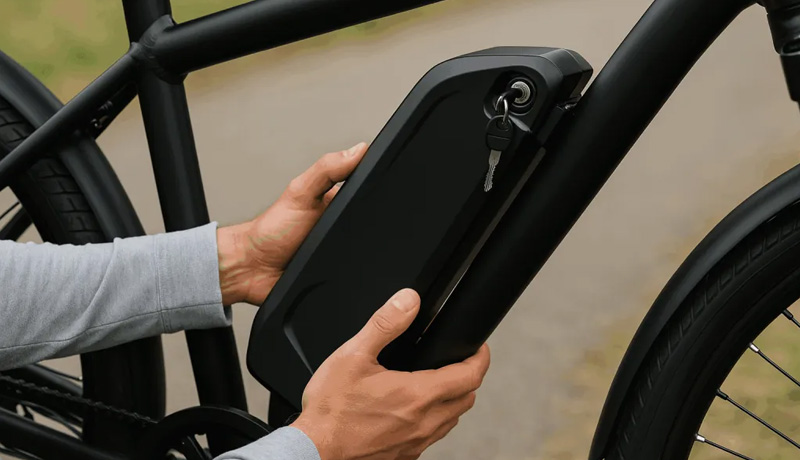
E-bike battery compartments (frame-integrated or rack-mounted) are custom-sized for the original battery. Even a 1cm difference in length/width/height will prevent the battery from fitting or locking securely.
How to measure:
- Remove the old battery from the e-bike.
- Measure length (L), width (W), height (H) in centimeters (cm) or inches (in)—include the casing and any protrusions (e.g., charging port, lock).
- Note the mounting points (e.g., slide-in rails, screw holes) and lock position.
Pro tip: Take photos of the old battery (front/back/side) to share with battery suppliers for confirmation.
4. Connector Type: Match the Plug
Your battery’s discharge connector (the plug that connects to the e-bike) must match the motor/controller’s plug. Using an adapter is risky (can cause overheating or short circuits). Common connector types:
- XT60 / XT90 (most common for mid-range e-bikes)
- Anderson Powerpole (heavy-duty for high-power e-bikes)
- JST / SM (smaller, for entry-level e-bikes)
- Custom OEM plugs (specific to brands like Bosch, Shimano, or Giant)
Key note: If replacing a brand-specific battery (e.g., Bosch PowerPack), opt for OEM or certified replacement packs—generic packs may not fit the connector or communicate with the e-bike’s display.
5. BMS Current Rating: Match Your E-Bike’s Power
The BMS (Battery Management System) in the replacement battery must handle your e-bike’s maximum discharge current. A mismatch causes BMS failure or limited power:
- 250W e-bikes: BMS rated for 20–30A
- 500W e-bikes: BMS rated for 30–40A
- 750W+ high-power e-bikes: BMS rated for 40–60A
Where to find it: Check the old battery’s BMS label (or ask the supplier for the replacement’s BMS specs).
Step 2: Choose Between OEM, Generic, or Custom Replacement Batteries
There are three main options for e-bike battery replacement—each with pros, cons, and price points:
1. OEM (Original Equipment Manufacturer) Batteries
Best for: Branded e-bikes (Bosch, Trek, Specialized, Giant) where compatibility is critical.
Pros: Perfect fit, full warranty, guaranteed compatibility with the e-bike’s electronics, high-quality cells/BMS.
Cons: Most expensive (2–3x the cost of generic packs).
Price range: $300–$800 (36V/48V, 10–20Ah).
2. Generic Aftermarket Batteries
Best for: Budget-friendly replacements for non-branded e-bikes (e.g., Amazon/eBay e-bikes).
Pros: Lower cost, widely available, often with upgradeable Ah (for extended range).
Cons: Variable quality (check reviews for cell/BMS specs), no warranty for e-bike damage.
Price range: $150–$400 (36V/48V, 10–20Ah).
3. Custom-Built Batteries
Best for: Extended range, unique fit requirements, or high-power e-bikes.
Pros: Tailored to your exact size/specs, use of premium cells (e.g., Samsung 21700, LG MJ1), higher Ah for maximum range.
Cons: Longer lead time (1–2 weeks), requires clear specs from you.
Price range: $200–$600 (depending on cells and capacity).
Extended Range Options: Beyond Basic Replacement
If you want more range than your original battery offered, these upgrades are safe and effective (as long as compatibility is confirmed):
1. High-Capacity Replacement Packs
Upgrade to a battery with the same voltage/size but higher Ah (e.g., 10Ah → 15Ah). This is the easiest way to add 50%+ range without modifying your e-bike.
Example: A 48V 15Ah battery (720Wh) vs. 48V 10Ah (480Wh) adds ~15–20 miles of range for a 250W e-bike.
2. Dual Battery Setup (Parallel Connection)
For serious range (80+ miles), install a second battery in parallel with your existing one (requires a compatible frame/rack and parallel connector).
Key rule: Both batteries must have the same voltage and BMS current rating (Ah can differ, but matching is better).
Note: Hire a professional if you’re not comfortable with wiring—incorrect parallel connections can damage BMS systems.
3. Optimize Battery Usage (No New Hardware Needed)
Extend range without replacement by:
- Using lower assist levels (e.g., Level 1–2 instead of 3–5)
- Keeping tires inflated to reduce rolling resistance
- Avoiding extreme temperatures (store/charge batteries at 10–25°C/50–77°F)
- Charging to 80% instead of 100% (reduces cell wear and extends cycle life)
Critical Safety Tips for E-Bike Battery Replacement
Improper replacement can cause fires, electric shock, or e-bike damage. Follow these rules:
- Always turn off the e-bike and disconnect the old battery before removing it.
- Inspect the new battery for damage (swelling, cracks) before installation.
- Ensure all connections are tight and insulated (use heat shrink tubing for loose wires).
- Charge the new battery with a matching voltage charger (e.g., 48V battery → 48V charger)—never use a higher-voltage charger.
- Dispose of the old battery at a certified recycling center (lithium-ion batteries are hazardous waste).
Common Mistakes to Avoid
- Buying a battery based only on voltage (ignoring size/connector/BMS specs)
- Using a "universal" adapter for mismatched connectors (risk of short circuits)
- Choosing the cheapest generic battery (often uses low-quality cells with short life)
- Overlooking mounting compatibility (e.g., a rack-mounted battery won’t fit a frame-integrated compartment)
Conclusion
Replacing an e-bike battery is a straightforward process when you prioritize spec matching (voltage, size, connector, BMS) and quality. OEM packs offer peace of mind, while generic/custom options balance cost and range. For extended range, high-capacity replacement packs are the simplest upgrade—just confirm the physical fit first.
By following these guidelines, you’ll avoid costly mistakes and ensure your new battery delivers reliable performance for hundreds of charge cycles.