E-Bike Battery Upgrade: Is Buying a Third-Party High-Capacity Pack a Smart Move or a Dangerous Gamble?
The promise of extended range and lower cost drives many riders to consider replacing their Original Equipment Manufacturer (OEM) e-bike battery with a high-capacity, third-party, aftermarket pack. While the immediate savings and increased Amp-hours (Ah) are appealing, this decision involves navigating significant technical, safety, and compatibility risks. This comprehensive guide provides an unbiased technical analysis to help you weigh the potential benefits against the critical dangers before making your final investment.
Part I: The Allure vs. The Risk – OEM vs. Aftermarket
The Motivation for Choosing Aftermarket (Pros)
- Cost Savings: Third-party packs are typically priced substantially lower than proprietary OEM replacements.
- Capacity Boost: Many aftermarket suppliers offer packs with a higher Watt-hour (Wh) or Amp-hour (Ah) rating than the original, providing a true range extension.
- Customization Potential: The ability to choose specific cell brands (e.g., Samsung, LG) or formats (e.g., 21700) tailored for specific power or range demands.
The Critical Technical Risks (Cons)
The risks associated with generic third-party packs are severe, primarily centering on system compatibility and public safety:
- Proprietary Communication Failure: Modern high-end e-bikes utilize complex, closed-source communication protocols (such as CAN Bus) between the battery's BMS and the motor controller. A generic aftermarket BMS almost always lacks the necessary firmware to "handshake" with the motor, resulting in system errors, power throttling, or a complete operational lockout.
- Voided System Warranty: Installing a non-OEM battery nearly always voids the warranty on the motor, controller, and often the entire frame, leaving the owner financially liable for any subsequent system failures.
- Unverified Safety Standards: The most acute danger. Cheap suppliers frequently use unverified, lower-grade, or even salvaged cells, coupled with inadequate BMS protection and poor assembly quality, significantly escalating the risk of internal short circuits and thermal runaway (fire).
Part II: Non-Negotiable Vetting Criteria for Third-Party Packs
1. Insist on Verifiable Safety Certification (The UL Requirement)
Do not accept vague assurances of quality. When considering any aftermarket battery, demand confirmation of third-party safety certification, such as UL 2271 (for light electric vehicle batteries) or UL 2849 (for the entire e-bike electrical system). A certificate confirms that the pack has been rigorously tested against short circuits, overcharging, and physical impact. If the supplier cannot provide proof of certification, the risk is unacceptable.
2. Validate Cell Provenance and Quality
The performance and safety of the pack depend entirely on the cells. Insist the supplier provide documentation confirming the use of Grade-A cells from reputable, name-brand manufacturers (Samsung, LG, or Panasonic). Cheap packs often use "B-stock" cells or dangerous counterfeits with unknown internal resistance, leading to rapid capacity degradation and increased fire risk under load.
3. BMS Specification and Current Rating
Verify that the Battery Management System (BMS) is engineered to meet or exceed your motor's maximum continuous current draw (Amperage). A weak BMS that cannot handle the motor's peak demand will fail prematurely, leaving the cells unprotected against over-discharge or short-circuit events, which are precursors to catastrophic failure.
Part III: Practical and Mechanical Compatibility Checklists
The Compatibility Triad
Compatibility is more than just voltage (V). Any replacement pack must satisfy three requirements:
- Electrical: Correct Nominal Voltage (e.g., 48V, 52V) and Discharge Connector Type.
- Communication: Correct BMS Firmware to 'talk' to the motor controller (the biggest aftermarket hurdle).
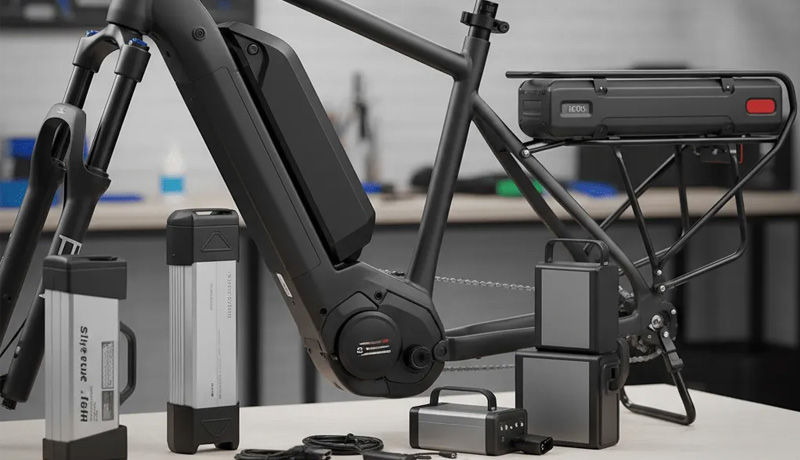
- Mechanical: Correct Physical Dimensions (L x W x H) and Mounting Mechanism (e.g., slide rail or integrated down tube fit) for the specific e-bike frame.
If purchasing online, always request confirmation from the seller demonstrating the pack functioning flawlessly on your exact make and model of e-bike, not just a generic voltage match.
Making the Informed Investment Decision.
The allure of a high-capacity, low-cost battery is powerful, but the risk of system failure, warranty voidance, and safety hazards are real. The decision ultimately rests on whether the potential savings justify the exposure to these complex technical risks. For most riders, verifying certification and compatibility is non-negotiable for safety.