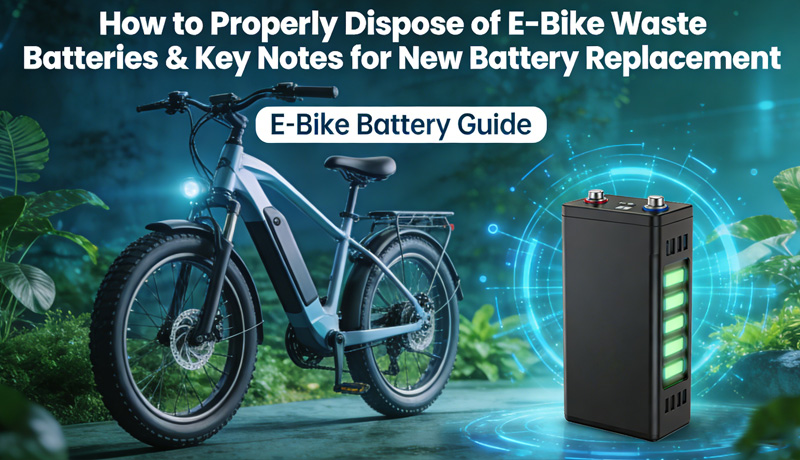
How to Properly Dispose of E-Bike Waste Batteries & Key Notes for New Battery Replacement
Electric bike (e-bike) batteries—primarily lithium-ion (Li-ion) and lithium-ferrophosphate (LFP)—are critical to performance, but they have a limited lifespan (2-4 years or 500-1,000 charge cycles). When an e-bike battery degrades beyond use (e.g., swelling, unable to hold a charge, or range drops by 40%+), proper e-bike waste battery disposal is non-negotiable for environmental protection and safety. Equally important is e-bike new battery replacement done correctly, as improper replacement can damage the e-bike, shorten battery life, or pose safety risks. This guide breaks down the professional process for e-bike waste battery disposal and essential considerations for new battery replacement, helping you navigate both tasks safely and responsibly.
Part 1: How to Properly Dispose of E-Bike Waste Batteries
E-bike lithium-based batteries contain toxic materials (e.g., lithium, cobalt, nickel) and flammable electrolytes. Improper e-bike battery disposal—such as throwing them in household trash, incinerating, or dumping—can leak harmful substances into soil and groundwater, cause fires, or explode. Global regulations (e.g., EU’s Waste Electrical and Electronic Equipment Directive, US EPA guidelines) mandate specialized recycling for e-bike batteries, and non-compliance may result in fines. Follow these steps for safe, legal e-bike waste battery recycling.
1.1 Identify Unusable Batteries (Waste Battery Criteria)
First, confirm if your battery is truly waste and requires disposal, rather than repairable. A battery is considered waste if it meets any of the following:
-
Swelling, bulging, or leakage (irreversible internal damage, high fire risk).
-
Capacity loss exceeding 40% (e.g., a 15Ah battery now holds less than 9Ah, leading to range below 60% of original).
-
Failed BMS (Battery Management System) that cannot be repaired, causing frequent shutdowns or overheating.
-
Physical damage (cracks, dents) from impacts or crashes, increasing short-circuit risk.
If the battery only has minor cell imbalance or BMS glitches, repair or cell balancing may extend its life—disposal should be a last resort.
1.2 Safe Handling Before Disposal
Waste e-bike batteries require careful handling to prevent short circuits, fires, or leakage during transport to recycling facilities:
-
Store the battery in a cool, dry place (15-25°C) away from flammable materials (paper, gasoline) and direct sunlight.
-
Wrap the battery terminals (positive and negative) with insulating tape to avoid contact with metal objects (e.g., keys, tools) that could cause short circuits.
-
Do not disassemble, puncture, or crush the battery—this releases toxic electrolytes and triggers thermal runaway.
-
If the battery is leaking or damaged, place it in a non-flammable, sealed container (e.g., a plastic box with sand) to contain leaks.
1.3 Legal Recycling Channels for E-Bike Waste Batteries
Household trash or curbside recycling bins are not suitable for e-bike batteries. Use these authorized channels for proper disposal:
a. E-Bike Manufacturer or Retailer Recycling Programs
Most reputable e-bike brands (e.g., Bosch, Yamaha, Giant) and local retailers offer take-back programs for waste batteries. They partner with certified recycling facilities to ensure compliant processing. Many retailers also offer incentives (e.g., discounts on new batteries) for returning old ones—check with your purchase store or the manufacturer’s official website for details.
b. Certified Battery Recycling Facilities
Look for facilities certified by regional environmental agencies (e.g., US EPA-certified, EU CE-certified) that specialize in lithium battery recycling. These facilities use professional equipment to disassemble batteries, separate toxic materials, and recover valuable metals (lithium, cobalt, nickel) for reuse in new batteries or other industries. You can find local certified facilities via government environmental portals or industry directories (e.g., Battery Council International).
c. Municipal E-Waste Collection Events
Many cities host regular e-waste collection drives, where residents can drop off small electronic devices and batteries—including e-bike batteries—for free. These events ensure waste is routed to authorized recyclers, avoiding illegal disposal. Check your local government’s waste management website for event schedules and drop-off locations.
1.4 What Happens to Recycled E-Bike Batteries?
Professional lithium battery recycling follows a strict, eco-friendly process:
-
Preprocessing: Batteries are discharged to eliminate fire risk, then sorted by type (Li-ion vs. LFP) and condition.
-
Disassembly: Non-battery components (plastics, metals casings) are removed and recycled separately.
-
Material Recovery: Batteries are shredded, and electrolytes are extracted and treated to neutralize toxicity. Valuable metals are recovered via hydrometallurgy (chemical extraction) or pyrometallurgy (high-temperature processing).
-
Treatment of Waste: Residual toxic materials are safely disposed of in compliance with environmental regulations, preventing soil or water contamination.
Some degraded but functional batteries undergo second-life utilization—reused in low-power applications (e.g., solar energy storage, electric scooters) before full recycling, maximizing resource efficiency.
Part 2: Key Notes for E-Bike New Battery Replacement
Choosing and installing a new e-bike battery requires strict adherence to specifications and safety standards—key to successful e-bike battery replacement. A mismatched or low-quality battery can damage the e-bike’s controller, motor, or wiring, and may even pose fire risks. Follow these professional guidelines for a reliable e-bike new battery installation.
2.1 Match Battery Specifications Exactly
The most critical step is ensuring the new battery matches your e-bike’s original specifications—no substitutions are recommended. Key specifications to verify:
a. Voltage (V)
E-bike batteries typically come in 36V, 48V, or 60V—this must match the e-bike’s controller and motor voltage. Using a higher-voltage battery (e.g., 60V for a 48V e-bike) will overload the controller and motor, causing immediate damage. A lower-voltage battery will fail to power the motor effectively, leading to weak performance and shortened range.
b. Capacity (Ah)
Capacity (ampere-hours) determines range—higher capacity (e.g., 15Ah vs. 10Ah) means longer rides, but it must fit the e-bike’s battery compartment. Capacity does not affect compatibility (as long as voltage matches), but oversized batteries may not fit or add excess weight, straining the e-bike’s frame.
c. Physical Dimensions & Connector Type
Measure the old battery’s length, width, and height to ensure the new battery fits the e-bike’s battery slot. Additionally, check the connector (plug) type—different brands use proprietary connectors, and a mismatched connector will not work (do not modify connectors, as this causes wiring issues).
2.2 Choose the Right Battery Type (Li-ion vs. LFP)
The two main e-bike battery types have distinct advantages—select based on your riding needs:
-
Lithium-Ion (Li-ion): Lightweight, high energy density, and fast charging. Ideal for commuter e-bikes where weight and range are priorities. Lifespan: 500-800 charge cycles. Drawback: More sensitive to overcharging/overheating.
-
Lithium-Ferrophosphate (LFP): More durable, safer (lower fire risk), and resistant to overcharging/extreme temperatures. Longer lifespan (800-1,200 charge cycles) but slightly heavier and lower energy density. Ideal for off-road e-bikes or users in harsh climates.
Ensure the new battery’s chemistry is compatible with your e-bike’s BMS—most modern e-bikes work with both, but confirm with the manufacturer.
2.3 Prioritize Certified, High-Quality Batteries
Avoid low-cost, unbranded batteries—they often lack proper quality control, have faulty BMS, or use substandard cells, increasing fire and failure risks. Look for batteries with these certifications:
-
UN38.3: International standard for lithium battery safety during transport.
-
CE (EU) or FCC (US): Compliance with regional safety and electromagnetic compatibility standards.
-
ISO 9001: Quality management system certification, ensuring consistent production standards.
Purchase from authorized retailers or the e-bike manufacturer to guarantee genuine products and warranty coverage (typically 1-2 years for new batteries).
2.4 Professional Installation & Wiring Checks
While some experienced users can replace batteries themselves, professional installation is recommended to avoid errors:
-
Disconnect Power First: Turn off the e-bike, remove the old battery, and disconnect the power cable to prevent short circuits during installation.
-
Secure Connections: Ensure the new battery’s connector is fully inserted into the e-bike’s wiring harness—loose connections cause intermittent power loss or overheating.
-
Fix the Battery Firmly: Use the original mounting brackets to secure the battery—vibration during riding can damage the battery or wiring if not properly fixed.
-
Post-Installation Inspection: A technician will test the battery’s voltage output, BMS functionality, and compatibility with the motor/controller to ensure safe operation.
2.5 Post-Replacement Calibration & Maintenance
After replacing the battery, follow these steps to optimize performance and extend lifespan:
-
Calibrate the BMS: Charge the new battery to 100%, then discharge it to 20% (ride until pedal assist weakens), and recharge to 100%—this calibrates the BMS to accurately display State of Charge (SOC).
-
Break-In the Battery: For the first 5-10 charge cycles, avoid fast charging and deep discharging (keep SOC between 20-80%) to stabilize cell performance.
-
Adopt Proper Charging Habits: Use the manufacturer-recommended charger, unplug after full charge, and avoid charging in extreme temperatures.
Part 3: Common Mistakes to Avoid
To prevent damage or safety risks during e-bike battery disposal and e-bike battery replacement, steer clear of these common errors:
-
Mixing old and new batteries: Never connect a new battery with a degraded one—this causes uneven charging and cell damage.
-
Modifying connectors or wiring: This voids warranties and increases short-circuit risk.
-
Ignoring battery swelling: A swollen new battery indicates a defect—stop using it immediately and request a replacement.
-
Disposing of old batteries illegally: Always use certified recycling channels to avoid environmental harm and legal penalties.
Trust ShunTongDa for E-Bike Battery Solutions
Whether you need guidance on waste battery disposal or high-quality new e-bike batteries, ShunTongDa offers professional support. We provide certified Li-ion and LFP e-bike batteries (36V/48V/60V) with reliable BMS, backed by quality certifications and warranty coverage. Our team also partners with authorized recycling facilities to ensure responsible disposal of your old batteries, and our certified technicians can handle battery replacement, calibration, and maintenance to keep your e-bike running safely.
Ready to address your e-bike battery needs? Contact us today to connect with our experts:
Note: ShunTongDa only operates through our official website (www.stdbattery.com). Verify the URL to avoid fraudulent interactions. Your safety and e-bike performance are our top priorities.
Proper e-bike waste battery disposal protects the environment and ensures safety, while careful new battery selection and installation guarantee long-term, reliable performance for your e-bike. By following these professional guidelines for disposal and e-bike battery replacement, you can make responsible choices and extend your e-bike’s service life.