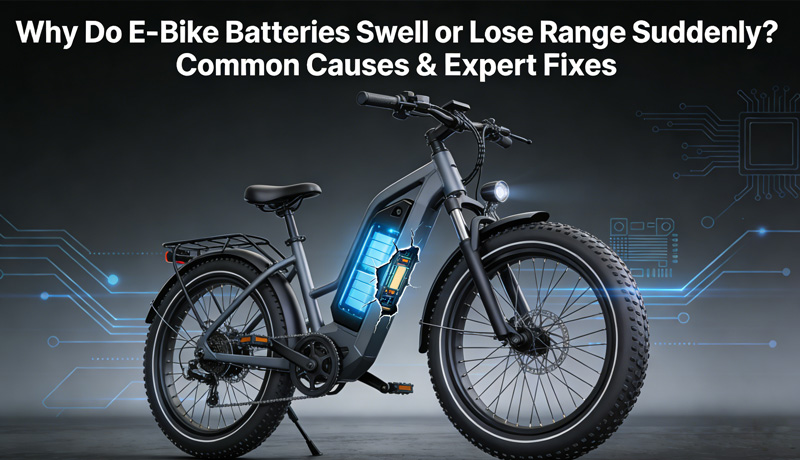
Why Do E-Bike Batteries Swell or Lose Range Suddenly? Common Causes & Expert Fixes
The battery is the lifeline of an electric bike (e-bike), powering its motor and determining ride range. Two of the most frustrating and potentially dangerous issues e-bike owners face are battery swelling (bulging) and sudden range loss—problems that often signal underlying damage or improper use. While lithium-ion (Li-ion) and lithium-ferrophosphate (LFP) batteries (the most common in e-bikes) are durable, they are sensitive to charging habits, temperature, and internal wear. This guide breaks down the root causes of these two critical battery issues, explains how to diagnose them, and offers professional solutions to protect your battery, extend its lifespan, and ensure safe operation.
Before diving into specific causes, it’s important to note that swelling and sudden range loss often overlap: a battery with internal damage may first show reduced range, then develop swelling as the issue worsens. Both problems require immediate attention—swollen batteries pose a fire or explosion risk and should never be used or charged, while sudden range loss indicates a decline in battery health that will worsen over time without intervention.
1. Common Causes of Both E-Bike Battery Swelling and Sudden Range Loss
These factors damage battery cells, leading to both performance degradation (range loss) and physical distortion (swelling). They are the most frequent culprits behind e-bike battery failures.
a. Overcharging or Improper Charging
Overcharging is the leading cause of e-bike battery damage. Most e-bike batteries are equipped with a Battery Management System (BMS) to prevent overcharging, but faulty chargers, aftermarket chargers, or a malfunctioning BMS can bypass this protection. When a battery is overcharged, excess current forces lithium ions to deposit unevenly on the anode, causing internal short circuits and the release of gas—this gas buildup leads to swelling. Simultaneously, overcharging degrades cell capacity, resulting in sudden range loss.
Using the wrong charger (e.g., a 60V charger for a 48V battery) or a charger with inconsistent voltage output also damages cells. Even partial overcharging, such as leaving the battery plugged in for hours after it reaches 100% capacity, accelerates degradation over time.
Diagnostic Tips: Check if your charger gets unusually hot during charging or if the battery remains warm hours after charging. If range drops sharply after switching to a new charger, the charger is likely incompatible.
Solutions: Always use the manufacturer-recommended charger. Unplug the battery immediately once it reaches full charge. Replace faulty or aftermarket chargers, and have a technician test the BMS if overcharging persists.
b. Extreme Temperature Exposure
Lithium-based batteries perform best between 15°C and 25°C (59°F and 77°F). Exposure to extreme heat or cold damages cells, triggering both swelling and range loss. High temperatures (above 35°C/95°F) accelerate chemical reactions inside the battery, causing electrolyte breakdown, gas release, and swelling. They also reduce cell capacity, leading to shorter ride ranges.
Extreme cold (below -10°C/14°F) is equally harmful: it slows ion movement, reducing the battery’s ability to deliver current (temporary range loss) and, if the battery is charged in cold conditions, can cause lithium plating (permanent cell damage). Over time, repeated exposure to cold followed by charging leads to internal damage and potential swelling.
Diagnostic Tips: If range drops drastically in hot or cold weather, or if the battery swells after being stored in extreme temperatures, temperature damage is likely.
Solutions: Store your e-bike and battery in a temperature-controlled area. Avoid charging or riding in extreme heat or cold. If you must ride in cold weather, warm the battery indoors before use (but never heat it directly).
c. Battery Aging and Cell Degradation
All lithium-based batteries degrade naturally over time and use. Typically, e-bike batteries last 2-4 years (or 500-1,000 charge cycles) before losing 20-40% of their original capacity. As cells age, their ability to hold a charge declines, leading to sudden range loss. Eventually, degraded cells may fail, causing internal short circuits and gas buildup—resulting in swelling.
Factors like frequent deep discharging (draining to 0%), fast charging, and heavy use (e.g., climbing steep hills regularly) accelerate aging. LFP batteries degrade more slowly than traditional Li-ion batteries but are still susceptible to these issues.
Diagnostic Tips: If your battery is older than 3 years, or if range has dropped by more than 30% over a few months, natural degradation is the cause. Swelling in an older battery indicates advanced cell failure.
Solutions: Replace degraded batteries—cell replacement is rarely cost-effective for older packs. Extend battery life by avoiding deep discharging (keep SOC between 20-80%), using slow charging when possible, and limiting heavy-load use.
2. Primary Causes of E-Bike Battery Swelling (Safety Risks)
Swelling is a serious safety hazard, as it indicates irreversible internal damage. The following causes are specific to battery bulging and often require immediate battery replacement.
a. Internal Short Circuit
Internal short circuits occur when the separator between the battery’s anode and cathode is damaged, causing the two electrodes to touch. This can happen due to overcharging, physical impact (e.g., dropping the battery or crashing the e-bike), or manufacturing defects. A short circuit triggers rapid chemical reactions, releasing large amounts of heat and gas—this gas buildup forces the battery case to bulge.
Internal short circuits can also be caused by metal debris (e.g., tiny screws or wires) inside the battery pack, which bridge the electrodes. This is more common in low-quality or poorly assembled batteries.
Diagnostic Tips: Swelling is the primary symptom of an internal short circuit. The battery may also feel unusually hot, even when not in use or charged.
Solutions: Stop using the battery immediately. Do not charge or store it near flammable materials. Dispose of swollen batteries at a certified battery recycling facility—never attempt to open or repair them.
b. Manufacturing Defects
Poorly manufactured batteries (e.g., those with faulty separators, inconsistent cell quality, or improper wiring) are prone to swelling. Defects may not appear immediately—they can manifest after a few months of use, especially when exposed to normal charging or mild temperature fluctuations. Low-quality LFP batteries, in particular, may have inconsistent cell chemistry, leading to premature failure and swelling.
Diagnostic Tips: Swelling in a new or relatively new battery (less than 6 months old) often indicates a manufacturing defect. This is especially true if you’ve followed proper charging and storage practices.
Solutions: Contact the manufacturer for a warranty replacement. Avoid purchasing low-cost, unbranded batteries—opt for reputable brands with certified quality control.
3. Primary Causes of Sudden E-Bike Range Loss (Performance Issue)
Sudden range loss (a drop of 20% or more in range over a short period) is often reversible if addressed early. It typically stems from issues with cell balance, BMS function, or external factors.
a. Battery Cell Imbalance
E-bike battery packs consist of multiple cells connected in series and parallel. Over time, cells degrade at different rates, leading to imbalance—some cells hold less charge or deliver less current than others. The BMS will limit power output to protect the weakest cells, resulting in sudden range loss. Cell imbalance does not always cause swelling, but it can lead to overcharging of stronger cells (if the BMS fails to compensate), eventually triggering bulging.
Cell imbalance is accelerated by frequent deep discharging, uneven charging, or a faulty BMS that fails to balance cells during charging.
Diagnostic Tips: Use a battery cell tester to measure voltage across individual cells—an imbalance of more than 0.1V indicates a problem. Range loss that worsens over weeks (not suddenly) may also signal cell imbalance.
Solutions: A certified technician can perform a cell balancing procedure to equalize voltage across cells (effective for minor imbalance). For severe imbalance, replace the faulty cells or the entire battery pack.
b. BMS Malfunction
The BMS regulates charging, discharging, temperature, and cell balance. A faulty BMS may incorrectly detect cell voltage, overheating, or low SOC, triggering unnecessary power limits that reduce range. For example, a malfunctioning BMS might think the battery is fully charged when it’s only 80%, leading to shorter ride times. It may also fail to protect cells from overcharging or undercharging, accelerating degradation and range loss.
Common BMS issues include loose connections, outdated firmware, or faulty sensors.
Diagnostic Tips: Erratic battery behavior (e.g., sudden shutdowns, incorrect SOC readings, or range loss after a firmware update) indicates a BMS malfunction.
Solutions: Reset the BMS by disconnecting the battery for 10-15 minutes and reconnecting it. If the issue persists, have a technician update the BMS firmware or replace the BMS module.
c. Undercharging or Voltage Drop
Undercharging occurs when the battery does not reach full capacity during charging, often due to a faulty charger, poor electrical connections, or charging interruptions. A battery that is consistently undercharged will have reduced range, as it cannot store the full amount of energy it once could. Additionally, if the battery’s voltage drops too low (below the minimum safe level, e.g., 30V for a 36V battery), the BMS will shut down the battery to prevent damage, leading to sudden range loss or complete failure.
Diagnostic Tips: If the battery takes less time than usual to charge or if the e-bike shuts down unexpectedly (even with a "full" charge indicator), undercharging or voltage drop is likely.
Solutions: Check the charger and battery connections for corrosion or looseness—clean or tighten them as needed. Replace faulty chargers. If voltage drops during use, have a technician test the battery’s internal resistance and BMS function.
4. How to Prevent E-Bike Battery Swelling and Range Loss
Most battery issues are preventable with proper care and maintenance. Follow these expert tips to protect your e-bike battery:
-
Use only the manufacturer-recommended charger and avoid aftermarket replacements.
-
Charge the battery to 80-90% for daily use (full charge only occasionally) and never leave it plugged in overnight.
-
Store the battery in a cool, dry place (15-25°C) away from direct sunlight and extreme temperatures.
-
Avoid deep discharging—recharge the battery when SOC drops to 20-30%.
-
Inspect the battery regularly for damage, corrosion, or swelling. Replace damaged batteries immediately.
-
Have the battery and BMS inspected by a certified technician annually.
Trust ShunTongDa for E-Bike Battery Solutions
If your e-bike battery is swelling, losing range suddenly, or showing signs of damage, ShunTongDa offers professional battery assessments, replacements, and repairs. Our team specializes in high-quality Li-ion and LFP e-bike batteries, BMS systems, and power management solutions—engineered to deliver reliability and long lifespan. We provide transparent diagnostics to identify the root cause of your battery issues and recommend cost-effective solutions, whether you need a battery replacement, BMS repair, or cell balancing service.
Ready to resolve your e-bike battery problems? Contact us today to connect with our experts:
By understanding the causes of e-bike battery swelling and sudden range loss, you can take proactive steps to protect your battery and avoid costly replacements. Proper charging, storage, and maintenance are the keys to extending your battery’s lifespan and ensuring a safe, reliable ride for years to come.