Robodog Commercial Power Systems: BMS, Batteries & Global Custom Services
In recent years, quadruped robots (robodogs) have moved beyond research labs to become essential tools across industries, and their performance relies heavily on high-quality robodog commercial power systems—the core focus of this blog. From hazardous industrial sites to search-and-rescue missions, reliability hinges on three key components: Battery Management System (BMS), lithium batteries, and tailored solutions. We’ll break down how BMS and batteries work in synergy, explore critical specifications, and highlight ShunTongDa’s global custom services that empower robodog manufacturers worldwide.
Robodog Applications: Fueling Demand for High-Performance Commercial Power Systems
Robodogs are reshaping industries with their ability to access tough terrain, operate continuously, and adapt to extremes—all placing strict demands on commercial power systems. As applications expand across industrial, civilian, and service sectors, the need for BMS and battery solutions tailored to specific scenarios surges. Below are the key sectors driving demand, and how our custom power systems align with their needs:
-
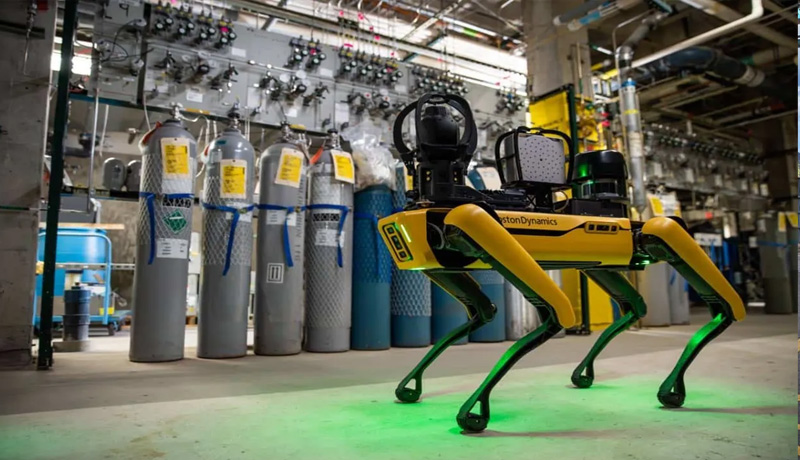
Industrial Inspection: In power plants, railways, and oil & gas fields,industrial robodogs conduct 24/7 patrols and monitoring, capturing data and detecting anomalies. These scenarios require commercial power systems with long battery life, stable discharge under heavy loads, and resistance to dust, vibration, and temperature fluctuations—critical for uninterrupted industrial operations.
-
Public Safety & Rescue: Search and rescue quadruped robots in disaster zones or law enforcement operations rely on high mobility, rapid response, and low-temperature adaptability. Their robodog power management systems must support sudden speed bursts and sustained operation in harsh conditions like snow or debris, meeting mission-critical requirements.
-
Firefighting & Training: Firefighting robodogs navigate high-temperature environments to conduct reconnaissance, while their counterparts are used for professional training simulations. Commercial power systems here demand heat resistance, high-power output for heavy-duty actuators and robotic joints, and reliable safety mechanisms to prevent thermal hazards.
-
Education & Research: Academic labs and AI research platforms use secondary development robodogs for algorithm testing and robotics research. These educational quadruped robots require open BMS interfaces, stable performance, and easy customization to support diverse experimental setups.
-
Consumer & Service Sectors: As robodog applications expand to civilian areas, AI interactive robodogs and home companions prioritize lightweight commercial power systems. These mass-produced quadruped robots are optimized for moderate loads and long idle times, balancing safety and aesthetic integration.
BMS & Intelligent Chips Synergy: The Backbone of Robodog Commercial Power Systems
The intelligent chip acts as the robodog’s "brain," governing motion control, sensor data processing (for multi-sensor fusion robodogs), and task execution. The BMS serves as the "power guardian" of commercial power systems, delivering consistent, safe energy to robotic joint power supply and core components. Their seamless collaboration via CAN 2.0/UART protocols enables real-time data exchange, forming the backbone of reliable quadruped robot power management.
This synergy starts with real-time data exchange: the BMS monitors voltage, current, temperature, SOC, and SOH at millisecond intervals, transmitting insights to the chip. The chip adjusts operations dynamically—reducing motor power to avoid over-discharge, activating cooling systems, or requesting higher discharge rates for sudden movements. This bidirectional flow optimizes power use, extends battery life, and safeguards commercial power systems from failures.
Essential BMS Functions for Robodog Commercial Power Systems
A high-performance BMS is non-negotiable for commercial robodog power systems, as it directly impacts safety, reliability, and operational efficiency—key factors for industrial and service-oriented robodog applications. Core functions include:
1. Precision Parameter Monitoring
The BMS tracks each cell’s voltage (0.5mV precision), total pack current, and multi-point temperature—critical for commercial power systems. This granular monitoring prevents cell imbalance, overheating, and overcurrent, ensuring stable operation for industrial robodogs (even lidar-equipped robodogs) under 2C~5C high-rate discharge.
2. Accurate SOC/SOH Estimation
SOC (remaining capacity) estimation accuracy directly affects mission planning. Advanced BMS uses algorithms like Kalman filtering to achieve ±3% SOC precision, eliminating "sudden shutdown" issues. SOH monitoring assesses battery health over cycles, alerting users to replace aging packs before failures occur—critical for mission-critical applications like rescue operations.
3. Multi-Layered Safety Protection
Comprehensive safety mechanisms include overcharge (voltage >4.2V/cell), over-discharge (voltage <2.8V/cell), overcurrent, short-circuit, and over-temperature protection. The BMS triggers immediate shutdown or alarm when anomalies are detected, and integrates pressure relief vents and thermal insulation to mitigate fire risks. For firefighting robodogs, this ensures the battery pack remains stable even at 150°C.
4. Cell Balancing & Thermal Management
Passive or active cell balancing maintains consistent voltage across all cells, extending battery cycle life by up to 30%—a cost-saving advantage for commercial power systems. Thermal management systems—such as phase-change materials or intelligent airflow control—regulate temperature, ensuring robodog battery packs perform in extreme environments (-20°C to 60°C) and reduce heat during high-rate discharge for robotic joints.
5. Flexible Communication & OTA Upgrades
CAN 2.0/UART support enables seamless integration with various robotic dog systems. Optional Bluetooth/cloud connectivity allows real-time monitoring via apps or backends, ideal for industrial IoT robodogs. Robodog over-the-air updates let users remotely upgrade BMS firmware, adding features without disassembling the robot.
6. Fast-Swap & Hot-Swap Compatibility
For 24/7 industrial operations, the BMS supports fast-swap battery designs with slide rail buckles and magnetic locking, enabling 5-second battery replacement. Hot-swap functionality minimizes downtime for commercial robodog power systems, allowing uninterrupted patrols and missions without shutting down the robot.
Lithium Battery Specifications for Robodog Commercial Power Systems: 18650 vs. 21700
The choice of lithium battery cells directly impacts the performance of robodog commercial power systems, depending on the robot’s size, weight, power demands, and cost budget. The two dominant cylindrical cell formats are 18650 and 21700, with leading brands including Samsung, LG, and Moli Energy offering specialized models for quadruped robot power solutions.
18650 Cells
Measuring 18mm×65mm, 18650 cells are mature, cost-effective, and lightweight (≈45g)—perfect for small-to-medium commercial robodogs like consumer companions or educational models. These 18650 cells for industrial robodogs and civilian robots offer 2500-3500mAh capacity and 15-20A max continuous discharge. LG’s 18650HG2 (3000mAh, 20A) and Samsung’s INR18650-25R (2500mAh, 20A) are top picks for cost-sensitive robodog power systems.
21700 Cells
The 21700 format (21mm×70mm) delivers 20-35% higher energy density than 18650, powering high-performance commercial power systems. These 21700 lithium batteries for heavy-duty robodogs offer 4000-5000mAh capacity and 30-35A continuous discharge, supporting industrial inspectors, rescue robots, and models needing strongrobodog payload capacity and robotic joint output. Key models include:
-
Samsung INR21700-50E: 5000mAh capacity, 3.7V nominal voltage, 9.8A continuous discharge, and 4.9A maximum charge current. It charges 12.5% faster (3.5 hours vs. 4 hours) than LG equivalents, ideal for applications needing quick recharge.
-
LG 21700M50T: 5000mAh capacity, 3.6V nominal voltage, 14.55A continuous discharge, and 25mΩ low internal impedance. It excels in high-load scenarios like sudden acceleration, with superior heat dissipation.
-
Moli Energy 21700: Offers customized high-rate models with 4500mAh capacity and 25A discharge current, balancing performance and cost for commercial robotics.
21700 cells also feature enhanced safety—thicker separators (16μm vs. 12μm for 18650) and higher thermal runaway thresholds (150°C vs. 130°C)—reducing fire risks in extreme environments. This makes them a preferred choice for mission-critical robodog commercial power systems.
ShunTongDa: Global Leader in Custom Robodog Commercial Power Systems & Services
As a global brand specializing incustom commercial power system solutions, ShunTongDa integrates BMS, lithium batteries, and industry-specific design into end-to-end services for industrial, service, and civilian robodogs. Our decades of expertise caters to emerging trends like embodied intelligence and unmanned collaboration—all while delivering the global custom services that make us a trusted partner for manufacturers worldwide.
Our core advantages include:
-
Customized System Design: We collaborate with clients to select optimal cell formats (18650/21700) and brands (Samsung/LG/Moli), design modular robodog battery packs with fast-swap capabilities, and develop BMS with open interfaces for seamless integration into commercial power systems.
-
Global Quality & Certification: All our power systems comply with international standards (UL2271, UN38.3, CE, IEC62133), ensuring reliability across global markets. We implement strict quality control from cell selection to pack assembly, with 100% testing for voltage, temperature, and safety performance.
-
Industry-Specific Optimization: For industrial inspection robodogs, we prioritize long endurance and dustproof power system designs; for rescue robots, we enhance low-temperature performance (-20°C operation) and high-rate discharge for robotic joints; for consumer models, we focus on lightweight and cost-efficient commercial power solutions.
-
Comprehensive Support: Beyond hardware supply, we offer OTA firmware updates, cloud-based battery monitoring platforms, and on-site technical support, ensuring our clients’ robodogs maintain peak performance throughout their lifecycle.
Whether you’re developing a compact companion robodog or a heavy-duty industrial platform, ShunTongDa’s customized power solutions are engineered to unlock your product’s full potential. Our global footprint and deep robotics expertise make us the trusted partner for commercial robodog manufacturers worldwide.
In the fast-evolving robodog market, commercial power systems (backed by advanced BMS and batteries) are the key to competitiveness. ShunTongDa’s strength lies in merging these technical components with global custom services—supporting trends like digital twin integration—to power the next generation of intelligent quadruped robots.
Ready to elevate your robodog’s performance with a tailor-made commercial power system? Whether you’re building industrial inspectors, rescue robots, or consumer companions, ShunTongDa’s expert team is here to turn your requirements into high-efficiency, safe power solutions. Click here to contact us now (https://stdbattery.com/pages/contact-us) to start a one-on-one consultation—we’ll customize BMS, battery pack, and integration plans that perfectly match your robot’s performance goals and industry scenarios, unlocking your product’s core competitiveness.