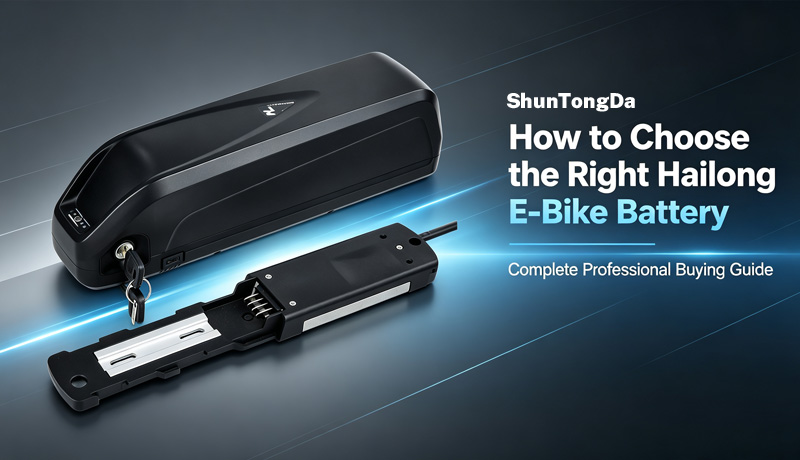
How to Choose the Right Hailong E-Bike Battery: Complete Professional Buying GuideConfused about picking a compatible Hailong downtube lithium battery for your electric bike? This technical guide covers Hailong 1/2/3 sizing, voltage, capacity, BMS current, cell grades, and real riding scenarios to avoid mismatch, cutouts and safety risks. Ideal for e-bike conversion, commuter and off-road riders.
Introduction
Hailong battery refers to the standardized streamline downtube lithium pack, the most widely adopted power solution for aftermarket e-bike conversion kits, modified mountain bikes and commuter electric bicycles worldwide. Unlike proprietary frame-integrated batteries, Hailong series features unified mold shells, detachable lockable design, full IP64–IP67 waterproofing and complete certification (UN38.3, CE, MSDS) for cross-border shipping and daily riding. Many riders encounter frustrating issues after improper selection: frame fitting failure, sudden power cutoffs during hill climbing, severe range attenuation, or even hidden fire hazards from low-grade recycled cells. This professional guide first breaks down core specifications of Hailong battery lineup, then delivers step-by-step actionable selection rules categorized by frame size, motor power, daily mileage and terrain, helping you match a safe, durable and cost-effective Hailong battery without overspending or performance compromise.
Part 1: Core Introduction to Hailong Battery Series
Three mainstream Hailong shell models dominate the market, each with fixed internal space limiting maximum capacity, weight and compatible motor wattage. All packs adopt NCM lithium cylindrical cells, built-in smart BMS with multi-protection circuits, key anti-theft lock, side LED charge indicator and independent power switch.
Hailong 1 (Standard Compact Model)
Dimension: 368×90×90mm; maximum capacity limit: 18Ah (18650) / 20Ah (21700); weight 3.5–4.6kg. Best fit narrow downtube frames, 250W–750W hub motors, city flat-road commuting. Lightweight for daily removal to charge indoors, the most universal replacement battery for entry-level converted e-bikes.
Hailong 2 (Extended Long Model)
Elongated internal cavity for larger cell arrays, supporting 20–30Ah capacity; weight 4.8–6.2kg. Matches 750W–1000W mid-drive/hub motors, riders with frequent hill climbs and medium-long distance trips. Balances capacity and portability, the top pick for mixed terrain mountain e-bikes.
Hailong 3 (Wide Large-Capacity Model)
Widest casing (370×166×102mm), maximum configurable capacity up to 40Ah; weight 6.5–9kg. Designed for heavy-duty cargo e-bikes, 1000W–1500W high-power off-road fat tire bikes and riders requiring 80+ mile single-charge range.
Standard voltage platforms for all three shells include 36V (10S), 48V (13S) and 52V (14S), paired with two mainstream cell formats: 18650 cost-effective cells (2500–3500mAh, 800–1000 full charge cycles) and premium 21700 high-energy cells (4000–5000mAh, 1000–1200 cycles, 15–20% lighter at equal capacity, lower internal resistance for stable high-current discharge). The integrated BMS undertakes overcharge, overdischarge, overcurrent, short-circuit and over-temperature protection; high-end versions add active cell balancing to extend overall service life by 20–30%.
Part 2: Step-by-Step Professional Selection Criteria for Hailong Battery
Step 1: Confirm Shell Model – Ensure Physical Frame Compatibility First
The primary prerequisite for any Hailong battery purchase is measuring your e-bike downtube battery cavity’s length, width and height, as shell dimensions cannot be modified.
If internal space ≤370×95×95mm: Only Hailong 1 is available; avoid blindly pursuing high capacity that cannot fit.
If downtube length exceeds 380mm and width under 120mm: Choose Hailong 2 for larger capacity without excessive weight.
If frame reserves wide downtube space or you own cargo/fat tire e-bikes: Select Hailong 3 for ultra-long range.
Critical reminder: Do not use adapter brackets to force oversized shells – loose mounting causes vibration damage to internal wiring and cell short-circuit risks.
Step 2: Match Exact Voltage with Motor & Controller (Non-Negotiable Safety Rule)
Voltage mismatch is the top cause of burnt controllers, broken LCD displays and permanent circuit failure. The battery nominal voltage must fully align with your e-bike’s original motor-controller system, no mixing allowed.
36V (10S NCM): Compatible with 250W–500W low-power city commuter bikes, flat urban roads only. Full charging voltage hits 42V, cut-off discharge voltage 28V.
48V (13S NCM): Industry mainstream, fits 500W–1000W motors, ideal for commuting with occasional slopes. Full charge 54.6V, the most balanced power-range solution for 90% of riders.
52V (14S NCM): High-performance platform for 1000W–1500W mid-drive off-road bikes, delivers stronger torque on steep climbs; only usable if your controller officially supports 52V input.
Step 3: Select Appropriate Capacity (Ah) Based on Daily Riding Mileage
Capacity determines real-world single-charge range (calculated as Wh = V × Ah). Below is verified flat-ground range reference for the popular 48V platform.
10–13Ah (480–624Wh): 30–45km range, daily commute under 30km, lightweight priority riders.
15–18Ah (720–864Wh): 50–70km range, best-selling balanced option for 30–40km daily trips with gentle slopes.
20–24Ah (960–1152Wh): 75–100km range, weekend long-distance riding, frequent passenger carrying.
30–40Ah (1440–1920Wh): 110–160km range, cargo delivery or all-day off-road touring, exclusively Hailong 3 shell.
Trade-off tip: Larger capacity adds weight and longer charging time; flat-city riders gain no practical benefit from oversized packs while sacrificing handling flexibility.
Step 4: BMS Continuous Discharge Current Matching – Eliminate Hill-Climb Cutoffs
Most low-quality Hailong battery failures stem from undersized BMS unable to sustain peak motor current. The core formula for required current: Working Current (A) = Motor Power (W) ÷ Nominal Voltage (V). Always reserve a 20% current margin for acceleration and climb surges to avoid overcurrent protection trigger.
250–500W / 36V motor: Minimum 20A continuous BMS
500–750W / 48V motor: Minimum 25A continuous BMS; hilly areas upgrade to 30A
1000W / 48V motor: Mandatory 30–40A continuous BMS
1200–1500W / 52V off-road motor: 40–50A high-current BMS with 70–90A peak tolerance
Active equalization BMS is strongly recommended for long-term use: it balances voltage differences between individual cells, preventing premature capacity decay and extending cycle life.
Step 5: Choose Cell Grade – Avoid Recycled/Refurbished Cell Traps
Cell quality decides safety and service lifespan, the most overlooked selection factor by budget-focused buyers.
18650 New A-Grade Cells (Eve, DMEGC): Cost-effective for daily commuting, 800+ cycles, stable flat-road performance. Avoid second-hand disassembled laptop cells with inconsistent internal resistance, prone to swelling and thermal runaway.
21700 New A-Grade Cells (Samsung, LG, Eve): Premium configuration for high-power and long-range builds, lighter weight, lower heat generation during heavy discharge, 1000–1200 full cycles before capacity drops below 80%.
Red flag warning: Ultra-low-priced “48V 40Ah Hailong 1” packs on cross-border platforms all use recycled cells, carrying severe fire risk and marked capacity inflation.
Step 6: Verify Connector, Waterproofing & Auxiliary Functions
Discharge Connector: Match original plug type (DC, XT60, XT90, XLR, Anderson) to eliminate adapter-induced heating and power loss.
Waterproof Rating: IP64 suits dry city riding; rainy coastal regions select IP67 casing (note: IP67 only resists splashing, never submerge the pack).
Must-have features: Mechanical anti-theft lock, independent power cutoff switch, real-time LED charge level indicator, matched dedicated charger with overcharge protection.
Part 3: Scenario-Based Ready-to-Use Hailong Battery Matching Schemes
Urban Flat-Road Commuter (Daily ≤30km, ≤750W motor) Hailong 1 Shell + 36V/48V 13–15Ah + 20–25A BMS + New A-Grade 18650 Cells
Mixed Terrain Mountain E-Bike (30–50km daily, 750–1000W motor, regular hills) Hailong 1 / Hailong 2 Shell + 48V 18–20Ah + 30A Active Balance BMS + 21700 Cells
High-Power Off-Road Fat Tire Bike (1000–1500W motor, steep mountain trails) Hailong 2 / Hailong 3 Shell + 52V 24–30Ah + 40–50A High-Current BMS + Premium 21700 Cells
Cargo Delivery & All-Day Long-Distance Touring Hailong 3 Shell + 48V/52V 30–40Ah + 50A Continuous Discharge BMS
Part 4: Common Buying Pitfalls & Safety Reminders
1. Ignore frame measurement and buy oversized shells, leading to unsteady installation and internal cell damage.
2. Mix different voltage battery and controller systems, destroying electrical components instantly.
3. Pair high-wattage motors with low-current BMS, causing sudden power cutoffs during climbing.
4. Purchase cheap packs assembled with recycled cells: severe capacity fade, swelling and fire hazards.
5. Misjudge range demand and overbuy large-capacity packs, increasing unnecessary vehicle weight.
6. Neglect certification: Non-UN38.3 packs cannot pass air/sea logistics for cross-border buyers.
For global riders, prioritize packs complete with UN38.3, CE, RoHS and MSDS documentation to avoid shipping detention. Store the battery at 20±5°C when idle, charge every 3 months during long storage to protect cell health.
Conclusion
Selecting a suitable Hailong downtube battery relies on six core dimensions: physical shell size matching frame cavity, voltage aligned with motor-controller system, capacity matching daily riding distance, BMS current supporting peak power demand, high-grade new lithium cells and compatible auxiliary connectors. By following the step-by-step technical standards and scenario matching plans in this guide, riders can avoid most compatibility and safety issues on the market. Whether you are a daily city commuter, off-road mountain bike enthusiast or cross-border e-bike retailer, a properly matched Hailong battery delivers stable power output, consistent long-range performance and extended service life, maximizing the return on your e-bike investment. Browse our premium selection of genuine, high-quality Hailong e-bike batteries to find your perfect match today.