 The Ultimate Guide to 36V/48V Ebike Replacement Battery: Professional Review & Selection Tips
For electric bike enthusiasts, commuters, and daily riders, the battery is the core component that determines the vehicle’s performance, range, and service life. As OEM (Original Equipment Manufacturer) ebike batteries degrade over time—typically losing 20-30% of their capacity after 2-3 years of regular use—finding a high-quality, compatible ebike replacement battery becomes a critical task. This professional blog will conduct an in-depth analysis of the 36V/48V 10.5Ah–14Ah Lithium-Ion Rear Rack Ebike Battery from stdbattery.com, covering its technical parameters, performance advantages, safety mechanisms, and practical application scenarios. It also provides professional guidance on selecting and maintaining lithium-ion ebike batteries, helping riders make informed decisions and maximize the value of their ebike upgrades.
1. Why Ebike Replacement Batteries Are Indispensable for Long-Term Use
Lithium-ion batteries, the mainstream power source for modern electric bikes, have a limited cycle life—usually 500-800 cycles for ordinary OEM batteries. When your ebike shows the following signs, it means it’s time to replace the battery:
-
Range reduction of more than 30% compared to the new battery (e.g., from 50km per charge to less than 35km);
-
Sluggish acceleration, especially when climbing slopes or carrying loads, due to insufficient discharge current;
-
Unstable voltage output, leading to frequent power cutoffs during riding;
-
Prolonged charging time (more than 1.5 times the original time) or failure to reach full charge;
-
Battery case bulging, overheating during charging/discharging, or abnormal noise.
Replacing the battery is far more cost-effective than purchasing a new ebike. A high-quality 48V ebike replacement battery or 36V ebike battery can restore the vehicle’s original performance, even exceeding it, while extending the ebike’s service life by 3-5 years. The rear rack battery reviewed in this article is not only a direct replacement for Evelo Compass adult electric bikes but also compatible with most adult ebikes equipped with rear rack mounting systems, making it highly versatile.
2. Professional Technical Parameters: The Foundation of Battery Performance
The performance of an ebike battery is directly determined by its core technical parameters. Below is a detailed breakdown of the key specifications of this 36V/48V rear rack lithium-ion battery, combined with professional interpretations to help riders understand its practical value:
2.1 Core Electrical Parameters
|
Parameter
|
Specification
|
Professional Interpretation
|
|
Nominal Voltage
|
36V / 48V (Dual Compatibility)
|
Matches the two most common ebike voltage systems. 36V is suitable for low-power (0-750W) commuter ebikes, while 48V is ideal for high-power (0-1000W) models, meeting diverse riding needs.
|
|
Nominal Capacity
|
7.8Ah–14Ah
|
Capacity directly determines the ebike’s range. A 10.5Ah 48V battery can provide a range of 40-60km for a 500W motor, while a 14Ah battery can extend the range to 60-80km, suitable for long-distance commutes or outdoor adventures.
|
|
Charge Cutoff Voltage
|
36V→42V; 48V→54.6V
|
The maximum voltage the battery can reach when fully charged. Exceeding this voltage will damage the battery cells, so the built-in BMS (Battery Management System) strictly controls the charging process.
|
|
Discharge Cutoff Voltage
|
39V (48V model)
|
The minimum safe voltage during discharge. Stopping discharge at this voltage prevents over-discharge, which can cause irreversible damage to lithium-ion cells and shorten battery life.
|
|
Rated Discharge Current
|
30A
|
A 30A continuous discharge current can stably support motors up to 1000W, ensuring strong power output during climbing and acceleration without voltage drop.
|
|
Cell Type
|
18650 Lithium-Ion Cells
|
18650 cells are the most mature and reliable lithium-ion cell type in the ebike industry, with high energy density (150-200Wh/kg), stable performance, and good heat dissipation.
|
|
Cycle Life
|
1000+ Full Charge Cycles
|
At 1000 cycles, the battery still retains 70% of its original capacity—far exceeding the industry average of 500-800 cycles—meaning it can be used for 3-5 years with regular use.
|
|
Operating Temperature Range
|
Charge: 0-45°C; Discharge: -10-60°C
|
Wide temperature adaptability, suitable for most regions and seasons. The discharge temperature range of -10°C ensures normal use in cold winters, while the 60°C upper limit prevents overheating in hot summers.
|
2.2 Physical & Installation Parameters
For a replacement battery, compatibility with the ebike’s frame and mounting system is crucial. This rear rack battery has the following physical characteristics:
-
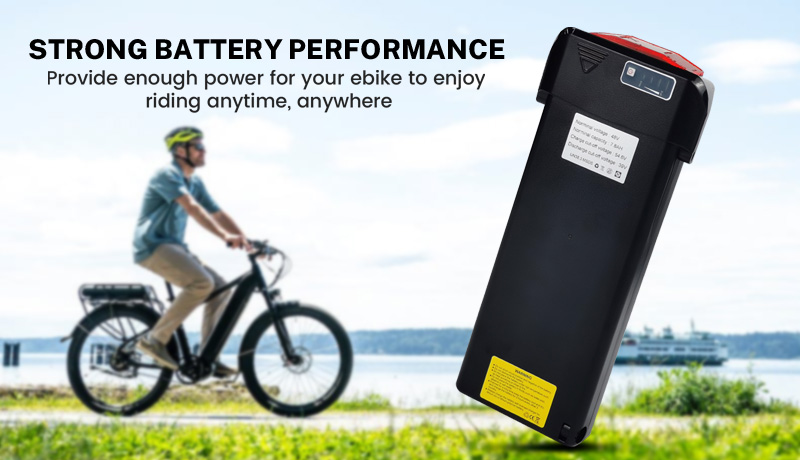
Dimensions: 340 × 148 × 74 mm—compact and lightweight, fitting most standard rear racks;
-
Weight: ~2.0 kg—easy to install and carry, reducing the overall load of the ebike;
-
Mounting Style: Rear rack installation—direct replacement for OEM rear rack batteries, no need to modify the frame;
-
Connectors: 4-pin discharge port + dedicated charge port—standard interface, plug-and-play, compatible with most ebike controllers and chargers.
Professional Tip: Before purchasing, always measure the installation space of your ebike’s rear rack and confirm the connector type to avoid compatibility issues. This battery also supports customization according to user needs (voltage, capacity, size, motor power), further improving compatibility.
3. Safety Mechanisms: The Core of Reliable Lithium-Ion Ebike Batteries
Lithium-ion batteries have high energy density, but improper use can lead to safety hazards such as overheating, short circuits, and even fire. This battery is equipped with a 30A BMS protection board, which integrates six layers of safety protection to ensure safe and reliable use:
3.1 Six Layers of BMS Protection
-
Short-Circuit Protection: Automatically cuts off the circuit when a short circuit occurs (e.g., damaged wires, incorrect connection), preventing battery overheating and fire;
-
Over-Charge Protection: Stops charging when the battery reaches the charge cutoff voltage, avoiding cell damage caused by overcharging;
-
Over-Discharge Protection: Cuts off the discharge circuit when the battery voltage drops to the discharge cutoff voltage, preventing irreversible damage to cells;
-
Over-Current Protection: Limits the discharge current to within 30A, avoiding excessive current that could damage the battery and motor;
-
Over-Load Protection: Shuts down the power supply when the load exceeds the battery’s bearing capacity, protecting the battery and controller;
-
Over-Heat Protection: Monitors the battery’s temperature in real time, cuts off the circuit when the temperature exceeds 60°C, and resumes operation when the temperature drops to a safe range.
3.2 Additional Safety Design
In addition to the BMS protection board, the battery also has the following safety features:
-
Taillight Integration: Built-in taillight improves visibility during night riding, reducing the risk of traffic accidents;
-
Red Seat Post Reflector: Enhances safety in low-light environments, making the rider more visible to other vehicles;
-
Power Switch: Clear "O" (off) and "I" (on) settings, preventing accidental startup and ensuring safe handling during installation and maintenance.
4. User-Friendly Design & Practical Application Scenarios
This battery is designed with user convenience in mind, combining professional performance with practical functions, suitable for a variety of riding scenarios:
4.1 User-Friendly Features
-
LED Power Indicator: Press the button to check the remaining battery power at any time, helping riders plan their trips and avoid running out of power on the road;
-
Easy Installation: Plug-and-play connectors and rear rack mounting design allow riders to install the battery in 5-10 minutes without professional tools;
-
Complete Package: Includes 1 battery pack, 1 charger, and 1 user manual—no additional accessories needed, ready to use out of the box;
-
US Local Shipping: Ships from the United States, with fast delivery via FedEx, free tax, and no customs fees, ensuring timely receipt for US riders (excluding Hawaii and Alaska).
4.2 Suitable Application Scenarios
-
Evelo Compass Owners: Direct replacement for the original battery, restoring the ebike’s performance to factory standards;
-
Daily Commuters: 10.5Ah–14Ah capacity provides sufficient range for daily commutes (20-80km), avoiding frequent recharging;
-
Delivery Riders: 30A continuous discharge current and 1000+ cycle life ensure stable performance during long hours of continuous use;
-
Outdoor Enthusiasts: Wide temperature adaptability and long range support outdoor adventures, even in harsh environments;
-
General Adult Ebike Users: Compatible with most 36V/48V rear rack ebikes, providing a cost-effective replacement option.
5. Professional Guide to Selecting Ebike Replacement Batteries
With the increasing number of ebike replacement batteries on the market, many riders struggle to choose the right one. Below are 5 professional selection principles to help you avoid pitfalls:
5.1 Match Voltage & Motor Power
The battery voltage must match the ebike’s motor voltage (36V battery for 36V motor, 48V battery for 48V motor). Using a mismatched voltage will damage the motor and controller. For motors with power above 750W, choose a 48V battery with a rated discharge current of at least 25A to ensure stable power output.
5.2 Confirm Capacity & Range Needs
Battery capacity (Ah) directly affects the range. Calculate your daily riding distance and choose a capacity that is 1.5-2 times your daily distance to avoid running out of power. For example, if you commute 20km daily, a 10.5Ah 48V battery is sufficient; for long-distance rides (50km+), choose a 14Ah battery.
5.3 Prioritize BMS Protection
Never choose a battery without a BMS protection board or with incomplete protection functions. A high-quality BMS is the key to preventing safety hazards and extending battery life. Prioritize batteries with 6-layer protection (short-circuit, over-charge, over-discharge, over-current, over-load, over-heat).
5.4 Check Compatibility (Dimensions & Connectors)
Measure the installation space of your ebike’s rear rack (length × width × height) and confirm the discharge/charge port type. Choose a battery with matching dimensions and connectors to avoid installation difficulties. If in doubt, contact the seller for customization.
5.5 Focus on Cell Quality & Cycle Life
Choose batteries using high-quality 18650 or 21700 lithium-ion cells from well-known brands. The cycle life should be no less than 800 cycles, and the battery should pass QC (Quality Control) tests before shipment to ensure reliability.
6. Maintenance Tips to Extend Battery Life
Proper maintenance can significantly extend the service life of your lithium-ion ebike battery. Follow these professional tips:
-
Charge the battery immediately after receiving it to activate the cells;
-
Use a compatible charger (matching voltage and current) to avoid over-charging or under-charging;
-
Charge the battery at least once every 3 months, even if it’s not in use, to maintain cell activity;
-
Avoid charging the battery in extreme temperatures (below 0°C or above 45°C);
-
Do not fully discharge the battery (stop using it when the power is below 20%) to prevent over-discharge;
-
Store the battery in a cool, dry place (10-25°C) when not in use, away from direct sunlight and high temperatures.
7. Final Verdict & Recommendation
After in-depth analysis of technical parameters, safety mechanisms, and practical performance, the 36V/48V 10.5Ah–14Ah Rear Rack Lithium-Ion Ebike Battery from stdbattery.com is a high-quality, reliable replacement option for Evelo Compass and other adult ebikes. Its advantages include dual voltage compatibility, high capacity, 1000+ cycle life, 6-layer BMS protection, easy installation, and user-friendly design. It is suitable for a variety of riding scenarios, providing riders with cost-effective solutions to restore their ebike’s performance.
For riders looking for a high-performance ebike replacement battery, this model is highly recommended. It not only meets the professional needs of daily use and outdoor adventures but also provides reliable after-sales support and fast US shipping. Don’t let a worn-out battery limit your riding experience—upgrade to this premium rear rack battery and enjoy consistent power, longer range, and safe riding.

 The Ultimate Guide to 36V/48V Ebike Replacement Battery: Professional Review & Selection Tips