What Happens If You Overcharge an Electric Bike? The Hidden Risks You Need to Know
As electric bikes (e-bikes) grow increasingly popular as an eco-friendly, cost-effective, and convenient alternative to cars and public transit, more riders are integrating them into daily life—raising common customer questions like “does overcharging damage e-bike battery permanently?” and “will overcharging void my e-bike warranty?” Whether commuting to work, running errands, or embarking on weekend adventures, e-bikes depend heavily on their batteries for reliable performance, which is why e-bike battery care and safe charging practices are top customer concerns. Yet one common habit among many e-bike owners often goes overlooked: overcharging the battery. Many people plug in their e-bikes overnight, assuming that “topping up” for as long as possible ensures maximum range the next day. Unfortunately, this misconception can lead to serious consequences—including reduced battery life, safety hazards, and even permanent damage to the e-bike itself—answering the critical customer question “what are the dangers of overcharging an e-bike?” In this blog, we’ll explore the hidden risks of overcharging in depth, explain why it harms your e-bike, share practical tips to protect your investment and keep yourself safe, and address the most common customer concerns about e-bike overcharging.
1. The Basics: How E-Bike Batteries Work (And Why Overcharging Breaks Them)
To understand why overcharging harms your e-bike—one of the most searched questions by e-bike owners—it’s crucial to first understand how its battery works. Most modern e-bikes use lithium-ion (Li-ion) batteries—the same technology powering smartphones, laptops, and electric vehicles, a point often asked in customer inquiries. Unlike older nickel-cadmium (NiCd) batteries, Li-ion batteries don’t require “deep cycling” (fully discharging and recharging) to maintain performance. Instead, they perform best when kept between 20% and 80% charge, with occasional full charges (once every few weeks) to calibrate the battery management system (BMS)—a key detail for anyone wondering “what’s the best way to charge an e-bike battery?”
A Li-ion battery consists of cells that store and release energy through chemical reactions. When you charge the battery, lithium ions move from the positive electrode (cathode) to the negative electrode (anode), where they are stored. When you use the e-bike, the ions move back to the cathode, generating electricity to power the motor. The BMS—a built-in safety feature in all quality e-bike batteries—monitors the charge level, voltage, and temperature of each cell to prevent overcharging, over-discharging, and short circuits, which addresses the common customer concern “does my e-bike have overcharging protection?”
The BMS is not infallible, though—especially if it’s low-quality, damaged, or worn out, a point that answers the customer question “can a faulty BMS cause overcharging?” If you leave your e-bike plugged in after it hits 100% charge, the charger will keep supplying power to the battery. This forces lithium ions to keep moving back and forth between the electrodes, even when there’s no more space to store them. Over time, this constant strain degrades the internal structure of the battery cells, leading to a range of problems—directly addressing the top customer search “e-bike battery damage from overcharging.”
2. Reduced Battery Lifespan: The Most Common (And Costly) Consequence
The single most significant impact of overcharging an e-bike is a dramatic reduction in battery lifespan—answering the frequent customer question “how much does overcharging shorten e-bike battery life?” Li-ion batteries have a limited number of charge cycles—typically between 500 and 1,000 full charge-discharge cycles—after which their capacity drops to around 80% of their original level. A “charge cycle” is defined as using 100% of the battery’s capacity, whether in one go or over multiple uses (e.g., using 50% one day and recharging, then using another 50% the next day counts as one full cycle)—clarifying a common customer confusion. Avoiding overcharging is also key to extending battery life, a top priority for most e-bike owners.
Overcharging accelerates this cycle degradation by damaging the battery’s electrodes and electrolyte—the substance that enables lithium ions to move. When a battery is kept at 100% charge for extended periods, its cathode degrades over time, losing the ability to hold lithium ions. Meanwhile, the anode may develop “lithium plating,” a process where lithium ions accumulate on the anode’s surface instead of being stored inside it. This plating not only reduces the battery’s capacity but also makes it far more susceptible to overheating and failure—addressing the customer question “what is lithium plating in e-bike batteries?”
Research shows that e-bike batteries kept at 100% charge 24/7 lose up to 30% of their capacity within just one year, compared to batteries that are charged to 80% and stored properly. For example, if your e-bike has a 500Wh battery (capable of a 50km range when new), overcharging could reduce its range to just 35km after a year—forcing you to replace the battery much sooner than necessary. E-bike batteries are expensive, often costing between $300 and $1,000, so extending their lifespan through proper e-bike battery care and charging habits can save you hundreds of dollars in replacement costs—answering the customer question “how much does an e-bike battery replacement cost?”
3. Safety Hazards: Overheating, Fires, and Explosions
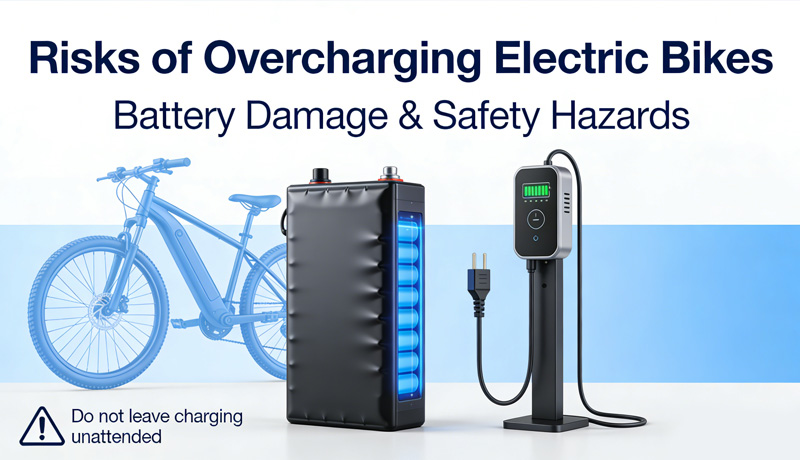
While reduced battery life is costly, the safety risks of overcharging are far graver—directly addressing the urgent customer question “is overcharging an e-bike dangerous?” Overcharging causes the battery to generate excess heat, a phenomenon known as “thermal runaway.” This occurs when the battery’s internal temperature rises to a point where its internal chemical reactions become uncontrollable, triggering a rapid surge in heat and pressure—answering “what is thermal runaway in e-bike batteries?,” a top safety-related customer concern.
Thermal runaway can lead to several dangerous outcomes: the battery may swell and rupture its casing, leak toxic chemicals (such as corrosive lithium hexafluorophosphate, which is harmful if inhaled or touched), catch fire, or even explode. E-bike battery fires are particularly perilous because they burn at extremely high temperatures—up to 1,000°C—and spread rapidly, endangering your home, property, and life. This addresses the customer question “can overcharging an e-bike cause a fire?” and highlights a critical risk of e-bike overcharging.
According to the U.S. Fire Administration, there were over 2,000 e-bike and e-scooter battery fires reported in 2023 alone, many of which were caused by overcharging. In one tragic case in New York City, an e-bike left charging overnight caught fire, killing two people and injuring several others. These incidents are not isolated—they highlight the very real danger of overcharging your e-bike, a key point for customers searching “e-bike overcharging safety incidents” or “US e-bike battery fire statistics.”
However, even “high-quality” batteries aren’t immune to these risks. While reputable brands use higher-grade materials and more advanced BMS technology, prolonged overcharging can still wear down the BMS over time, increasing the risk of failure. Cheap, counterfeit batteries—often sold online for a fraction of the cost of genuine ones—are even more dangerous: they typically have poorly designed (or non-existent) BMS and low-quality cells that are prone to overheating and failure. This answers the customer questions “do genuine e-bike batteries prevent overcharging?” and “are cheap e-bike batteries safe?,” as well as related searches like “genuine vs counterfeit e-bike batteries” and “safe e-bike battery brands.”
4. Damage to the Charger and E-Bike Electronics
Overcharging doesn’t just harm the battery—it can also damage the charger and other electronic components of your e-bike, answering the customer question “can overcharging damage my e-bike charger?” The charger is designed to stop supplying power once the battery reaches 100% charge, but if you leave it plugged in for hours (or days) on end, the charger has to work continuously to maintain the battery’s charge. This constant workload can cause the charger to overheat, leading to damage to its internal circuits and components.
A damaged charger may stop working entirely, or it may supply inconsistent voltage to the battery—worsening e-bike battery damage. In some cases, a faulty charger can even cause short circuits in the e-bike’s electrical system, harming the motor, controller, or display. Repairing or replacing these components adds to the overall cost of e-bike ownership, making overcharging even more costly in the long run—answering the customer question “how much does e-bike charger repair cost?”
Overcharging can also cause voltage spikes in the e-bike’s electrical system. These spikes can harm sensitive electronic components like the BMS, motor controller, and sensors, leading to malfunctions. For instance, a damaged motor controller might cause the e-bike to accelerate unexpectedly, or the display could stop showing accurate battery levels—leaving you unsure of how much charge you have left. This answers the customer question “why is my e-bike display showing wrong battery level?” and aligns with searches like “e-bike electrical malfunction causes” and “e-bike sensor repair.”
5. How to Avoid Overcharging Your Electric Bike (Practical Tips)
Now that you understand the risks of overcharging, let’s explore some simple, practical steps to protect your e-bike battery, charger, and yourself—directly addressing the most searched customer question: “how to stop overcharging my e-bike.” These tips also align with best practices for e-bike battery care, which is a top concern for all e-bike owners.
-
Avoid overnight charging: This is the most important tip. Never leave your e-bike plugged in overnight or for extended periods (more than 2-3 hours after it reaches 100% charge). Set a timer or reminder to unplug the charger once the battery is fully charged—answering “how long should I charge my e-bike battery?”
-
Charge to 80% for daily use: For regular daily use, charge your battery to 80% instead of 100%. This reduces stress on the battery and extends its lifespan. Save full charges (100%) for longer rides when you need the maximum range—addressing “what percentage should I charge my e-bike battery?”
-
Use the original charger: Always use the charger that came with your e-bike (or a genuine replacement from the manufacturer). Cheap, counterfeit chargers are often poorly designed and can damage the battery or cause safety hazards—answering “can I use a different charger for my e-bike?”
-
Store the battery properly: If you’re not going to use your e-bike for an extended period (e.g., a few weeks or months), store the battery at 40-60% charge in a cool, dry place (avoid extreme temperatures, both hot and cold)—aligning with “how to store e-bike battery in winter” and “e-bike battery storage tips.”
-
Check the BMS regularly: Inspect your e-bike’s battery for signs of damage (swelling, leaking, or discoloration) and ensure the BMS is working properly. If you notice any issues, stop using the battery immediately and contact a professional—answering “how to check e-bike BMS functionality?”
-
Invest in a smart charger: If your e-bike doesn’t come with one, consider purchasing a smart charger. Smart chargers automatically stop supplying power once the battery is fully charged and can even adjust the charging rate based on the battery’s temperature and voltage, further protecting it from damage—addressing “what is a smart e-bike charger?” and “best smart chargers for e-bikes.”
6. Customer Relationship FAQs: Top Questions About E-Bike Overcharging
To better serve e-bike owners and address the most common customer concerns—key for building strong customer relationships—we’ve compiled and answered the top questions about e-bike overcharging, directly tied to customer searches and inquiries:
-
Q: Will overcharging my e-bike void the manufacturer’s warranty? A: In most cases, yes. Many e-bike manufacturers explicitly state that improper charging (including overcharging) voids the battery and e-bike warranty. Always check your owner’s manual or contact customer support for details—addressing “does overcharging void e-bike warranty?”
-
Q: I accidentally overcharged my e-bike overnight—what should I do? A: First, unplug the charger and let the battery cool down. Inspect the battery for signs of swelling, leaking, or overheating. If no damage is visible, you can continue using it, but avoid overcharging in the future. If you notice any issues, contact a professional or the manufacturer—answering “what to do after overcharging e-bike battery?”
-
Q: Do all e-bikes have overcharging protection? A: Most modern e-bikes with quality Li-ion batteries have a built-in BMS that prevents overcharging, but this protection can wear out or fail over time (especially with low-quality batteries). Never rely solely on the BMS—always unplug the charger once fully charged—aligning with “e-bike overcharging protection.”
-
Q: How often can I overcharge my e-bike before it’s damaged? A: There’s no “safe” number of times to overcharge an e-bike. Even occasional overnight charging can degrade the battery over time. Consistent overcharging will accelerate damage, leading to reduced lifespan and safety risks—answering “is occasional e-bike overcharging safe?”
-
Q: Can I get my overcharged e-bike battery repaired? A: In most cases, damage from overcharging (such as lithium plating or electrode degradation) is permanent and cannot be repaired. You will likely need to replace the battery. Contact your e-bike manufacturer or a certified repair shop for an assessment—addressing “can overcharged e-bike battery be repaired?”
7. Conclusion: Protect Your E-Bike (And Yourself) By Avoiding Overcharging
Overcharging an electric bike is a common mistake with severe consequences—from shorter battery life and higher replacement costs to life-threatening safety risks—answering the core customer question “what happens if you overcharge an electric bike?” By understanding how e-bike batteries work and following the simple e-bike charging tips in this blog, you can protect your investment, extend your battery’s lifespan, and safely enjoy all the benefits of e-bike ownership. Addressing customer concerns and providing clear, actionable advice is key to building trust and strong customer relationships—whether you’re an e-bike owner or a retailer serving this growing market.
Remember: Your e-bike’s battery is its heart, and proper charging habits are the key to keeping it healthy. Avoid the temptation to leave it plugged in overnight, charge to 80% for daily use, use the right charger, and store the battery properly. By doing so, you’ll get the most out of your e-bike for years to come—aligning with the top goals of every e-bike owner.
Do you have any questions about e-bike battery care? Or have you experienced issues with overcharging in the past? Let us know in the comments below—we’d love to hear from you! For more e-bike charging tips, check out our related blogs on “e-bike battery storage in winter” and “how to choose a safe e-bike charger.”