Advanced Commercial Drone Power Systems: BMS Integration, Semi-Solid Batteries & Custom Solutions
Commercial unmanned aerial vehicles (UAVs) have become indispensable across modern industries, enabling aerial inspection, logistics delivery, agricultural mapping, and emergency response. Their reliability, flight endurance, and operational performance are inherently determined by commercial drone power systems—a integrated ecosystem comprising drone BMS (Battery Management System), high-energy-density batteries, modular power modules, and application-specific control architectures. As UAV requirements evolve toward extended flight durations, heavier payload capacities, and harsh environment adaptability, advanced power solutions have emerged as a critical differentiator. This article explores the core components of drone power systems, the synergistic integration of BMS with flight controllers, cutting-edge battery technologies (including semi-solid lithium batteries), and how ShunTongDa delivers tailored power solutions for global commercial UAV deployments.
Key Commercial Drone Applications: Driving Power System Advancements
Diverse commercial UAV use cases impose distinct requirements on power systems, pushing the boundaries of energy density, thermal management, and scalability. Core sectors driving innovation in drone power technology include:
-
Industrial Inspection: UAVs deployed in power plants, wind farms, and oil & gas facilities require long-endurance industrial inspection drone power solutions to cover extensive areas continuously. These systems must withstand mechanical vibration, extreme temperatures (-20°C to 60°C), and support high-power payloads such as LiDAR and high-resolution imaging equipment, with robust drone BMS ensuring stable operation.
-
Logistics & Last-Mile Delivery: Delivery drones rely on lightweight, high-energy-density batteries to extend operational range while accommodating payloads. drone fast-swap battery packs and modular power architectures minimize fleet downtime, aligning with the scalability needs of commercial delivery operations.
-
Agriculture & Mapping: Agricultural drones for seeding and spraying, as well as mapping UAVs, need stable power output for extended hover times and precise maneuvering. Power systems must adapt to varying terrain and weather conditions.
-
Emergency Response & Public Safety: Rescue and surveillance UAVs operate in harsh environments, requiring ruggedized power systems with short-circuit protection and low-temperature drone power packs. tethered power systems for commercial drones enable 24/7 continuous flight for emergency lighting and real-time monitoring, supported by advanced drone BMS for fault mitigation.
-
Media & Entertainment: Aerial photography drones demand compact power modules that free up space for audio-visual equipment, without compromising flight stability or duration.
Synergistic Integration of BMS, Flight Controllers & E-Drive Systems
Modern commercial UAVs depend on the tight integration of three core subsystems—flight controller (FC), e-drive system, and BMS—to ensure optimal performance and operational safety. This "triple-loop integration" forms a closed-loop control mechanism that regulates energy flow, flight stability, and fault response, addressing the system-level "barrel effect" that undermines standalone component designs in commercial drone power systems.
The BMS functions as the central energy management hub, continuously monitoring key battery parameters—cell voltage (with 0.5mV precision), total current draw, temperature distribution, State of Charge (SOC), and State of Health (SOH)—and transmitting real-time data to the flight controller via CAN bus or UDP protocols. The flight controller dynamically adjusts flight parameters based on this input: reducing payload power consumption when SOC drops below 20%, optimizing motor RPM to balance energy efficiency and maneuverability, or initiating emergency landing protocols if the BMS detects overheating or overcurrent events.
Conversely, the flight controller communicates mission-specific demands to the BMS, such as requesting peak power for rapid ascent or activating energy-saving modes during hover. The e-drive system—comprising brushless DC (BLDC) motors and inverters—responds to control signals, while the BMS regulates current output to match motor load, ensuring efficient power conversion with minimal energy dissipation. This bidirectional synergy not only maximizes flight time but also enhances fault tolerance, a critical requirement for mission-critical UAV operations like search-and-rescue.
Critical Capabilities of Commercial Drone BMS
A high-performance BMS is a non-negotiable component for commercial UAVs, as it directly impacts operational safety, flight endurance, and long-term reliability. Advanced drone BMS must possess the following core capabilities:
1. Precision State Estimation & Energy Management
Using algorithms like Kalman filtering, the BMS achieves ±3% SOC estimation accuracy, eliminating unexpected shutdowns during missions. It also calculates SOH based on cycle life and aging characteristics, providing predictive maintenance alerts. For long-endurance drones, this enables accurate range forecasting and optimal energy allocation between flight systems and payloads.
2. Multi-Layered Safety Protection
Comprehensive safety mechanisms include overcharge (voltage >4.2V/cell), over-discharge (voltage <2.8V/cell), short-circuit, overcurrent, and thermal protection. The BMS triggers immediate power cutoff or fault alerts when anomalies occur, preventing thermal runaway—a critical risk in high-density battery packs. Ruggedized designs resist vibration and impact, adapting to industrial and emergency scenarios.
3. Thermal & Cell Balancing Optimization
Active cell balancing maintains consistent voltage across all cells, extending battery cycle life by up to 30% compared to passive balancing technologies. Integrated thermal management systems—utilizing phase-change materials (PCMs) or intelligent airflow control—regulate battery temperature, ensuring stable performance in extreme environments and mitigating heat generation during high-rate discharge (2C~5C) for rapid maneuvers.
4. Seamless Communication & OTA Upgrades
Support for CAN 2.0, UDP, and UART protocols enables integration with various flight controllers and ground stations. OTA (Over-the-Air) upgrade capability allows remote firmware updates, adding new features like advanced energy-saving algorithms without disassembling the drone. Real-time data transmission to ground stations facilitates fleet-wide power monitoring and performance analysis.
5. Tethered & Fast-Swap Compatibility
For 24-hour continuous operations (e.g., perimeter surveillance, emergency response), the BMS supports tethered power systems, enabling seamless switching between battery power and ground-based high-voltage DC supply (up to 400V). Fast-swap battery designs facilitate 2-minute battery replacement for delivery and inspection fleets, minimizing operational downtime.
Cutting-Edge Battery Technologies for Commercial UAVs
Battery technology is a defining factor in a UAV’s flight endurance, payload capacity, and operational scope. Modern commercial drones leverage two primary power solutions: semi-solid lithium batteries and 48V drone modular power systems, with cylindrical cell configurations and customized form factors catering to specific use cases—from compact inspection UAVs to heavy-lift cargo drones.
1. Semi-Solid Lithium Batteries
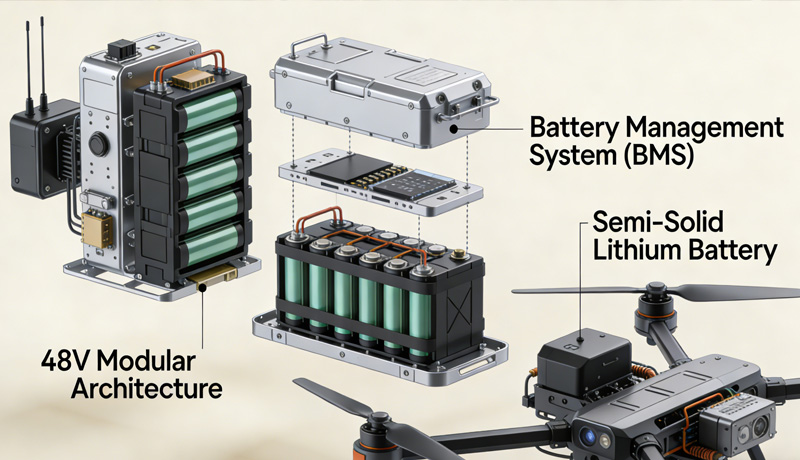
Semi-solid lithium batteries have established themselves as the industry standard for professional commercial UAVs, offering superior energy density (up to 320 Wh/kg) and enhanced safety profiles compared to conventional lithium-ion batteries. Key technical specifications include:
-
Capacity & Voltage: Options range from 16,000 mAh to 88,000 mAh, with voltage configurations (22.2V, 44.4V, 51.8V, 66.6V) matching drone power architectures. A 27,000 mAh 44.4V pack delivers 1.2 kWh of energy, extending flight time by 40% compared to conventional Li-ion packs.
-
Durability & Cycle Life: ≥800 cycles at 80% Depth of Discharge (DoD), with resistance to vibration, impact, and extreme temperatures (-20°C to 60°C)—ideal for industrial and outdoor applications.
-
Customization: Tailored connectors (XT90, AS150, Anderson) and waterproof housings adapt to specific drone models, from compact inspection UAVs to heavy-lift delivery drones.
2. 48V Modular Power Architectures
48V drone modular power systems are gaining traction in high-performance commercial UAVs, enabling efficient power conversion and scalable design. ShunTongDa’s 48V drone power modules, paired with modular DC-DC converters (e.g., Vicor BCM, DCM series), deliver peak efficiency of 96-98%, converting high-voltage input (up to 800V) to 48V SELV (Safety Extra-Low Voltage) for UAV subsystems. Key benefits include:
-
High Power Density: Compact modules (as small as 10x10x2.56 mm) free up payload space, with power outputs up to 1300W for heavy-lift drone battery systems—a key focus of commercial UAV power system customization.
-
Thermal Efficiency: Low heat generation reduces cooling system weight, improving overall drone agility.
-
Scalability: Parallel modules adapt to varying power demands, supporting fleet-wide standardization across different drone platforms.
3. Tethered Power Systems
For continuous-operation scenarios, tethered power systems convert 220V AC to 400V DC, transmitting power to the UAV via lightweight nickel-alloy cables (80m length, <2.8mm diameter). These systems enable 24-hour uninterrupted flight for surveillance and emergency lighting applications, with ground control stations featuring real-time fault alerts and OTA upgrade capabilities. Portable backpack designs (7.5kg) support rapid deployment in remote locations.
ShunTongDa: Global Provider of Custom Commercial Drone Power Solutions
As a global leader in customized commercial power systems, ShunTongDa integrates advanced custom drone BMS, semi-solid lithium batteries, and 48V modular architectures to deliver end-to-end power solutions for commercial UAVs. Our engineering expertise spans all key application sectors—from industrial inspection to emergency response—with a focus on performance optimization, operational safety, and scalability of commercial drone power systems.
Our core capabilities include:
-
Tailored System Design: We collaborate with clients to develop custom battery packs (semi-solid/lithium-ion), open-interface BMS, and modular power modules—optimizing energy density, weight, and compatibility with specific UAV models (including DJI Matrice and industrial-grade platforms). Custom connectors and IP67-rated waterproof housings ensure adaptability to harsh operating environments.
-
Triple-Loop Integration Validation: Our BMS solutions are engineered for seamless integration with flight controllers and e-drive systems, enabling system-level energy flow optimization and fault tolerance. We validate performance through hardware-in-the-loop (HIL) simulation, ensuring reliability in extreme operating conditions.
-
Global Quality & Certification: All power systems comply with international standards (UL2271, UN38.3, CE), with rigorous testing for vibration, temperature resistance, and safety. Our semi-solid battery packs meet aviation regulations for commercial drone operations worldwide.
-
Fleet-Scale Support: We provide fast-swap battery designs, tethered power integration, and OTA firmware management, supporting large-scale drone fleets with minimal downtime and maximum operational efficiency.
Ready to enhance your commercial UAV’s performance with a tailored power system? Whether you require extended flight time, harsh environment adaptability, or fleet-wide standardization, ShunTongDa’s engineering team delivers customized commercial drone power systems aligned with your operational goals. Contact us today to schedule a one-on-one consultation and unlock your UAV’s full potential.